
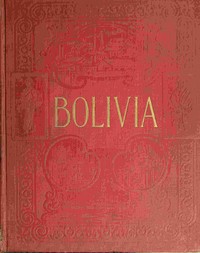
Bolivia : The central highway of South America, a land of rich resources and…
Published in 1904, Marie Robinson Wright's book is part travel guide, part national portrait, and completely a product of its fascinating moment. She traveled through Bolivia shortly after the devastating War of the Pacific, which left the country landlocked. Her mission was ambitious: to document a nation picking up the pieces and to introduce its potential to the English-speaking world.
The Story
There isn't a traditional plot, but there is a clear journey. Wright structures her book like a grand tour. She starts with the geography and history, setting the stage. Then, she takes us with her from city to city—La Paz, Sucre, Potosí—meeting everyone from government officials to local workers. She describes the stunning, harsh landscapes of the Altiplano, the immense silver mines of Potosí that once funded empires, and the bustling markets. The "story" is her quest to understand Bolivia's past struggles, its present challenges after the war, and its possible future as a nation rich in resources but searching for a new path forward.
Why You Should Read It
You should read this for the perspective. Wright isn't a detached observer. You feel her effort to be fair, her fascination with the culture, and her firm belief in Bolivia's potential. It's a view of Bolivia from the outside, but a sympathetic one. She argues passionately that the world is overlooking a key player in South America. Reading it now, over a century later, adds another layer. You see what she predicted correctly, what she missed, and how the Bolivia of 1904 echoes in the country today. Her descriptions are vivid and make you feel the altitude of La Paz or the awe of seeing Lake Titicaca.
Final Verdict
This book is perfect for history lovers, travel writing fans, and anyone curious about South America. It's not a fast-paced modern adventure; it's a thoughtful, detailed portrait. You'll need a little patience for the old-fashioned style, but the reward is a unique window into a pivotal time. Think of it as having a conversation with a sharp, well-traveled great-grandmother about a trip that truly mattered. If you want to understand the roots of modern Bolivia, this is a compelling and personal place to start.
This work has been identified as being free of known copyright restrictions. Access is open to everyone around the world.
Charles Brown
4 months agoI found the data interpretation to be highly professional and unbiased.
Matthew Garcia
1 month agoThe clarity of the introduction set high expectations, and the transition between theoretical knowledge and practical application is seamless. Highly recommended for those seeking credible information.
Sarah Thompson
1 month agoIt took me a while to process the complex ideas here, but the historical context mentioned in the early chapters is quite enlightening. I'm genuinely impressed by the quality of this digital edition.
Joseph Smith
9 months agoComparing this to other titles in the same genre, the step-by-step breakdown of the methodology is extremely helpful for students. I'll be citing this in my upcoming project.


Susan Garcia
3 weeks agoInitially, I was looking for a specific answer, but the clarity of the writing makes even the most dense sections readable. I am looking forward to the author's next publication.