
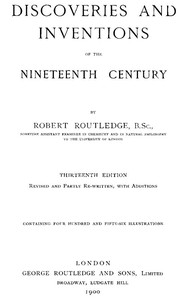
Discoveries and Inventions of the Nineteenth Century by Robert Routledge
Forget dusty timelines and lists of names. Robert Routledge's book is a guided tour through a century of pure, unadulterated astonishment. Written in the 1890s, it looks back on the 1800s not as distant history, but as a recent, breathtaking revolution. The author acts as our excited narrator, walking us through the inventions that reshaped everything.
The Story
There isn't a traditional plot with heroes and villains. Instead, the 'story' is the collective human drama of problem-solving. Routledge organizes the chaos of progress into clear chapters. He shows us the world before the steam engine, then details how it shrank continents. He explains the birth of photography, letting people capture moments for the first time. He walks through the development of electric light, synthetic dyes, and the telegraph. Each section builds on the last, painting a picture of a society in hyper-drive, where each new discovery unlocked the next. The narrative tension comes from the sheer scale of change—from horse-drawn carriages to locomotives, from handwritten letters to instant communication across oceans.
Why You Should Read It
What makes this book special is the perspective. Reading it today is a double revelation. First, you get a crystal-clear explanation of how foundational technologies actually work, written for a curious layperson. Second, and more powerfully, you feel the author's genuine awe. Routledge isn't a detached academic; he's a witness saying, "Look what we just did! Can you believe it?" His enthusiasm is contagious. It makes you appreciate the sheer audacity of inventors who turned ideas into world-altering reality. It reframes our own tech-saturated world, reminding us that the feeling of rapid change isn't new—our great-great-grandparents lived through the original version.
Final Verdict
This book is perfect for anyone with a curious mind who loves 'how things work' documentaries or the history of ideas. It's for the reader who looks at an old photograph or rides on a train and wonders about the first people who ever did those things. It's not a critical analysis of social impacts; it's a celebration of ingenuity from someone who was there. If you want to feel the excitement of the 19th century, straight from the source, pick this up. You'll never look at a light switch or a text message the same way again.
Nancy Lopez
8 months agoTo be perfectly clear, the storytelling feels authentic and emotionally grounded. Truly inspiring.
Kimberly Martinez
1 year agoI have to admit, the character development leaves a lasting impact. I will read more from this author.
Charles Thompson
1 year agoSolid story.
William Sanchez
2 months agoI came across this while browsing and the clarity of the writing makes this accessible. I learned so much from this.

Andrew Young
5 months agoI didn't expect much, but the character development leaves a lasting impact. A true masterpiece.