
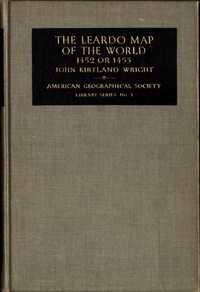
The Leardo Map of the World, 1452 or 1453 by John Kirtland Wright
If you're expecting a dry analysis of coastlines and compass roses, think again. John Kirtland Wright's study of the Leardo Map is a biography of a single, spectacular object. Created by Venetian priest Giovanni Leardo around 1452, this world map is a stunning mix of the known and the imagined. Wright doesn't just catalog its features; he asks the big questions. Why does Jerusalem sit at the center? What stories are hiding in the drawings of strange creatures at the margins? He guides us through Leardo's world, where the geography of the Bible was as real as the trade routes to Asia.
The Story
There isn't a plot in the traditional sense. Instead, Wright carefully unpacks the map itself. He shows us how Leardo combined hard-won knowledge from sailors and merchants with ancient myths and religious teachings. We see the three known continents—Europe, Africa, Asia—arranged in a circle, surrounded by ocean. But then we notice the details: the Garden of Eden placed as a real location, the legendary kingdom of Prester John, and notes about races of people with faces in their chests. Wright acts as our translator, explaining what each element meant to a European living on the brink of the Age of Discovery, just before Columbus would change everything.
Why You Should Read It
This book is a quiet revelation. Wright writes with a scholar's precision but a storyteller's curiosity. He makes you feel the weight of that parchment—not just as a navigational tool, but as a prayer, a statement of belief, and a work of art. The most compelling part is seeing the world through Leardo's eyes. His map isn't 'wrong'; it's complete in a way modern maps can never be. It includes humanity's dreams and dreads. Reading it, you realize that every map, even the one on your phone, is shaped by the values and blind spots of its creators. It's a humbling and fascinating perspective.
Final Verdict
Perfect for history buffs who love deep dives into specific artifacts, or for anyone who's ever gotten lost looking at an old map in a museum. It's also a great pick for readers interested in how people make sense of their world. You don't need to be a geography expert—Wright gives you all the context you need. If you enjoy books that use one small thing to open a window into an entire lost mindset, this concise and thoughtful volume is a hidden gem waiting for you.

Elizabeth Anderson
11 months agoI came across this while browsing and the pacing is just right, keeping you engaged. Worth every second.