1

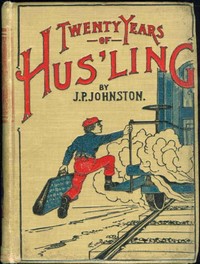
Twenty Years of Hus'ling — Reading Notes
(0 User reviews)
1319
Project Gutenberg
2008
Not confirmed
Business; Johnston, J. P. (James Perry), 1852-
Readers of public-domain and historical texts
Project Gutenberg digital edition
en
Edition facts
Words
119,362
Reading time
519 min
Text sections
14
Twenty Years of Hus'ling — Reading Notes can be approached with a clearer sense of reading commitment from its source measurements: 119,362 words, 8 hr 39 min estimated reading time, and 14 detected text sections.
The text analysis averages about 20.7 words per sentence, while the detected sections provide another way to judge how the source is divided.
Project Gutenberg metadata also associates the work with “Business,” connecting these edition facts with the source record’s subject description.
Source:
Project Gutenberg record #25087
J. P. Johnston's 1900 memoir recounts two decades of failed ventures and comic scrapes, told in a folksy, self-deprecating voice. The narrative shifts from earnest apology to farcical set-pieces, as when the author sabotages a rival's dance by claiming he has fits.
Read the complete public-domain text at its original source.
Read on Project GutenbergJ. P. Johnston's Twenty Years of Hus'ling opens with an apology: the book began as a sketch appended to his Auctioneer's Guide but grew into a separate volume. The author's voice is immediately present—earnest, self-justifying, and aware of his audience. He addresses the reader directly, framing his story as a lesson for those 'pulling hard against the stream.' Yet the excerpts reveal a narrator who undercuts his own moralizing with comic detail. The dedication 'To the Hus'lers of America' sets a tone of rugged individualism, but the episodes that follow are less about triumph than about narrow escapes, petty schemes, and the absurdity of trying every business in turn.
A Voice Between Apology and Farce
The narrative voice in Twenty Years of Hus'ling oscillates between the moralizing tone of the apology and the farcical energy of the anecdotes. In the opening, Johnston writes as a reformed man offering wisdom: 'for the sole purpose of stimulating those who may have been for years pulling hard against the stream.' But the excerpt from the dance scene shows a different register—quick, colloquial, and mischievous. The narrator describes the Doctor 'balancing around, with his plug hat on the back of his head, his spectacles hanging over his nose, and grasping his gold-headed cane.' The prose becomes breathless, piling up details: the soiled napkin mistaken for a handkerchief, the 'regular Highland-fling step,' the cross-eyed girl's dumbfounded stare. This shift from reflective to performative suggests a storyteller who enjoys the chaos he creates.
Pace and the Set-Piece Structure
The excerpts show a marked change in pace between the expository chapters and the comic set-pieces. The table of contents lists a rapid sequence of failures—'Collapse of a chicken deal,' 'Arrested and fined my last dollar'—each chapter a new venture that ends in disaster. But the dance scene slows time dramatically. The narrator's whispered lie about the Doctor's fits, the Doctor's escalating fury, and the floor-manager's patronizing response unfold in a series of quick exchanges and physical comedy. Johnston uses repetition for effect: the Doctor shrieks 'Fits? fits? What! I have fits?' and later 'Good ——! do I look like a man who has fits?' The pacing mimics a stage farce, with characters entering and exiting, misunderstandings piling up, and the narrator slipping away just before the climax.
Recurring Details: The Step-Father and the Fiddle
Two recurring details anchor the memoir's early chapters. The first is the step-father, introduced in Chapter I as 'a kind step-father' who helps the young Johnston raise a flock of sheep from a pet lamb. This figure reappears as a source of loans and stability, in contrast to the narrator's own reckless schemes. The second is the fiddle: Johnston's trip to New York ends with 'my return home with my fiddle,' a detail that suggests a musical or artistic side to the hustler persona. The excerpts do not reveal whether the fiddle becomes a plot point, but its presence hints at a desire for expression beyond commerce. These small, specific elements—the lamb, the fiddle, the repeated 'more help from Mr. Keefer'—give the narrative a texture of real memory, even as the comic episodes strain credibility.
Readers approaching Twenty Years of Hus'ling should attend to the gap between Johnston's stated purpose—to inspire the struggling—and the actual texture of his stories, which are often cynical, funny, and unresolved. The book rewards those who enjoy a narrator who is both the hero and the butt of his own jokes. Pay attention to the illustrations by W. W. Denslow, which likely amplify the comic tone. The memoir is best read not as a success manual but as a performance of failure, one that uses pace and voice to turn mishaps into entertainment.
Reading Johnston’s scrapes, I kept thinking how differently we’d be told to fail today—with charts and plans. There’s a quiet comfort in his haphazard honesty. It made me curious about the era’s more orderly side, so I lingered over Up To Date Business Including Lessons in Banking, Exchange, Business Geography, Finance, Transportation and Commercial Law — Edition Insights. Two worlds, the messy and the methodical, each oddly reassuring.
There are no reviews for this eBook.
There are no comments for this eBook.
Reader reflection
Record your reading impressions
A brief reflection can help important ideas stay with you longer.
Your progress
0
/
10
2
What was your overall reaction to the book?
3
Would you pass this book on to a friend?
4
Did the language feel accessible?
5
Was the book moving at the right speed?
6
How would you rate its originality?
7
Did this book create an emotional response?
8
Was the book what you thought it would be?
9
Which lesson or insight stayed with you?
10