1

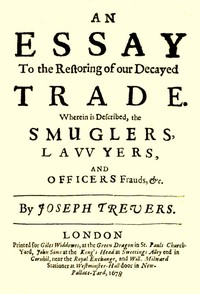
An Essay to the Restoring of our Decayed Trade. Wherein is Described, the Smuglers, Lawyers, and Officers Frauds &c. — Reading Notes
(0 User reviews)
688
Project Gutenberg
2014
Not confirmed
Wool industry -- England -- Early works to 1800; Great Britain -- Commerce -- Early works to 1800
Readers of public-domain and historical texts
Project Gutenberg digital edition
en
Edition facts
Words
22,016
Reading time
96 min
Text sections
9
For An Essay to the Restoring of our Decayed Trade. Wherein is Described, the Smuglers, Lawyers, and Officers Frauds &c. — Reading Notes, the stored edition analysis reports 22,016 words, 1 hr 36 min estimated reading time, and 9 detected text sections.
The text analysis averages about 53.3 words per sentence, while the detected sections provide another way to judge how the source is divided.
Project Gutenberg metadata also associates the work with “Wool industry -- England -- Early works to 1800,” connecting these edition facts with the source record’s subject description.
Source:
Project Gutenberg record #47509
Joseph Trevers's 1678 pamphlet argues that England's wool trade is in decline due to smuggling, legal loopholes, and official corruption. The text catalogs specific statutes, contrasts English advantages with Dutch competition, and proposes remedies, all while targeting Parliament and the merchant class.
Read the complete public-domain text at its original source.
Read on Project GutenbergJoseph Trevers's 1678 pamphlet opens with a bold claim: no nation has greater natural advantages for enriching itself than England. Yet the work's title page immediately signals a narrower focus—the frauds of smugglers, lawyers, and officers. Trevers dedicates the essay to Edward Seymour, Speaker of the House of Commons, positioning his argument as a direct appeal to legislative authority. The table of contents lists twelve numbered points, from the advantages of English wool to the poverty caused by trade decay, suggesting a systematic, evidence-driven approach rather than a general lament.
Statutes as Evidence
Trevers does not merely assert that laws are broken; he recites specific statutes by regnal year and chapter. For instance, he cites Stat. 4. H. 4. ca. 15 requiring merchants to bring wool, woolfells, leather, or lead to the Staple, and Stat. 17 E. 4. cap. 1 forcing foreign merchants to reinvest their English proceeds in domestic goods. He then lists over forty statutes concerning wool and clothing, from 25 Edw. 3. Cap. 4 to 39 Eliz. Stat. 11, referring readers to the statutes themselves. This reliance on legal citation gives the pamphlet the character of a legal brief, grounding its economic arguments in the authority of parliamentary acts.
The Smuggler as Traitor
Trevers reserves his harshest language for those who transport wool and fullers earth abroad. He writes that such offenders “destroy as much as in them lyes, the happiness of a whole Kingdome” and are worse than highway thieves, who only take “part of a particular mans Estate.” The smuggler, by contrast, brings “many thousands to great miseries and languishing deaths.” This moral framing elevates an economic crime to treason against the commonwealth. Trevers also notes that the penalty for transporting sheep or wool is felony, yet fears the severity of the law may deter informers, who are “cautelous” about touching a man’s life.
Dutch Competition and English Complacency
One of Trevers's twelve points addresses “the industry of the Dutch, and other Countries, whereby in a great measure they undermine our Trade.” Though the excerpts do not detail the Dutch methods, the mere inclusion of this point shows Trevers is aware of international competition. He contrasts English natural advantages—wool and fullers earth that no other country can match for good cloth—with the failure to capitalize on them. The pamphlet thus combines protectionist sentiment with a call to revive neglected statutes, suggesting that legal enforcement, not innovation, is the key to restoring trade.
Readers should approach this essay as a primary source on late-seventeenth-century economic thought, not as a complete history of the wool trade. Trevers's reliance on statute law and his targeting of specific abuses—smuggling, legal fraud, official corruption—make the pamphlet a focused polemic. The twelve-point structure and the dedication to a parliamentary speaker indicate an intended audience of policymakers. The excerpts leave unclear how Trevers proposed to balance enforcement with the risk of over-penalizing informers, a tension worth noting.
I keep returning to Trevers’s old rage about wool and fraud, and it puts me in mind of another shelf, where earnest students once mapped Venezuela for our traders. Both whisper of commerce as a fragile, hopeful thing. That latter volume, Venezuela, an economic report Presented by students of the School of Foreign Service, as an aid to the foreign trade of the United States — Context and Discussion, feels like a patient nephew to that cantankerous uncle.
There are no reviews for this eBook.
There are no comments for this eBook.
Reader reflection
Your personal reading reflection
Build a private reading journal entry for this title.
Your progress
0
/
10
2
How much did you enjoy the reading experience?
3
Would you pass this book on to a friend?
4
How easy was the book to follow?
5
Do you expect to return to this book?
6
Did you gain anything practical from the text?
7
How did the reading compare with what you expected?
8
Which element worked best for you?
9
In one sentence, what did you learn?
10