1

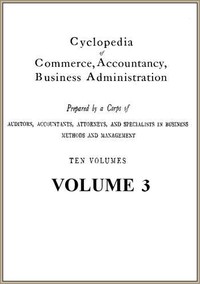
Cyclopedia of Commerce, Accountancy, Business Administration, v. 03 (of 10) — Inside the Classic
(0 User reviews)
451
Project Gutenberg
2014
Not confirmed
Business; Commerce; Accounting
Readers of public-domain and historical texts
Project Gutenberg digital edition
en
Edition facts
Words
121,169
Reading time
527 min
Text sections
20
Cyclopedia of Commerce, Accountancy, Business Administration, v. 03 (of 10) — Inside the Classic can be approached with a clearer sense of reading commitment from its source measurements: 121,169 words, 8 hr 47 min estimated reading time, and 20 detected text sections.
The text analysis averages about 17.4 words per sentence, while the detected sections provide another way to judge how the source is divided.
Project Gutenberg metadata also associates the work with “Business,” connecting these edition facts with the source record’s subject description.
Source:
Project Gutenberg record #46489
This volume of the Cyclopedia series presents a detailed exposition of suretyship law, using numbered sections and hypothetical examples to distinguish surety, guarantor, and indorser obligations. The text's instructional voice and systematic structure reflect its early 20th-century correspondence-school origins.
Read the complete public-domain text at its original source.
Read on Project GutenbergThe third volume of the Cyclopedia of Commerce, Accountancy, Business Administration opens with a dense legal exposition on suretyship, immediately establishing its pedagogical tone. The text employs numbered sections (e.g., §183, §184) and repeated hypothetical transactions involving parties labeled A, B, and C to illustrate contractual distinctions. This methodical approach, typical of early 20th-century correspondence courses, prioritizes clarity over narrative flow. The voice is authoritative yet plain, avoiding rhetorical flourish in favor of precise definitions and conditional statements. Notably, the excerpt repeatedly emphasizes that a surety's obligation is unconditional, contrasting it with a guarantor's conditional promise. This granular focus on legal nuance suggests the volume aims to equip business practitioners with actionable knowledge rather than theoretical overview.
Numbered Pedagogy and Structural Repetition
The text relies heavily on a numbered-section structure, with each paragraph advancing a single legal point. For instance, §183 defines suretyship broadly, then immediately breaks it into three party roles—principal, creditor, promisor—using a consistent example (A orders goods from B, C promises to pay). This repetition of the same scenario across multiple sections reinforces learning through variation. The pattern recurs in §184, where a promissory note example is dissected to show how a surety's signature creates identical liability to the principal. The prose is deliberately redundant: phrases like “the debt of another” appear multiple times per paragraph, mirroring the instructional method of early distance education. This structural choice prioritizes memorization over concision, a hallmark of the correspondence-school genre.
Hypotheticals as Argument Engines
The author constructs legal arguments almost entirely through hypothetical transactions. In §183, the A-B-C framework is used to distinguish primary from secondary obligations: A’s debt is primary, while C’s promise to pay if A fails is suretyship. The hypothetical is then varied in §184, where C signs as “Surety” on a promissory note, creating an unconditional obligation. The text explicitly states that a creditor may sue the surety without first demanding payment from the principal. These examples are not merely illustrative; they function as the primary vehicle for legal reasoning. The absence of real-world case citations or statutory references suggests the volume is designed for self-study, where abstract scenarios must stand in for practical experience. The language remains consistently conditional (“if A does not pay”), mirroring the contingent nature of the contracts described.
Voice of the Correspondence Instructor
The narrative voice is that of a distant instructor speaking through print. Sentences are declarative and directive: “A surety is one who unconditionally promises to answer for the debt or obligation of another.” The text frequently uses “for example” to introduce hypotheticals, and it addresses the reader indirectly through third-person constructions. There is no first-person “I” or “we”; instead, authority is vested in the material itself. The prose is unadorned, with no metaphors or stylistic flourishes. Legal terms are defined immediately upon introduction (“He is known in law as a guarantor”). This voice reflects the ethos of the American School of Correspondence, which aimed to replicate classroom instruction through written lessons. The tone is patient but firm, assuming no prior legal knowledge while demanding careful attention to distinctions.
Readers approaching this volume should expect a systematic, example-driven exposition rather than a narrative or argumentative text. The numbered sections and repeated hypotheticals reward sequential reading; skipping ahead may obscure the incremental buildup of legal distinctions. The volume’s value lies in its methodical unpacking of contractual nuances, making it a useful reference for those seeking to understand early 20th-century business law pedagogy. However, its narrow focus on suretyship within a single excerpt suggests the complete work likely covers a range of commercial topics with similar rigor.
Flipping through the Cyclopedia of Commerce’s dry sections on suretyship, I found myself unexpectedly wistful. Its numbered, hypothetical world feels so orderly, so certain. That made me think of Venezuela, an economic report Presented by students of the School of Foreign Service, as an aid to the foreign trade of the United States — Context and Discussion, where that same earnest, systematic hope meets a far messier reality. Different subjects, yet the same faint perfume of a confident era.
There are no reviews for this eBook.
There are no comments for this eBook.
Reader reflection
How will you remember this book?
Save your reaction, strongest insight, and memorable passage.
Your progress
0
/
10
2
How did the book work for you overall?
3
Is this a title you would suggest to others?
4
How easy was the book to follow?
5
Which part made the strongest impression?
6
How understandable was the text?
7
Did it raise ideas you would like to talk about?
8
How original did the book feel?
9
What is the main idea you are taking away?
10