1

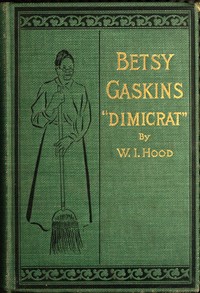
Betsy Gaskins (Dimicrat), Wife of Jobe Gaskins (Republican) Or, Uncle Tom's Cabin Up to Date — Reading Companion
(0 User reviews)
1319
Project Gutenberg
2017
Not confirmed
Money; Paper money -- United States; Interest; Gold; Populism
Readers of public-domain and historical texts
Project Gutenberg digital edition
en
Edition facts
Words
106,408
Reading time
463 min
Text sections
54
Before opening Betsy Gaskins (Dimicrat), Wife of Jobe Gaskins (Republican) Or, Uncle Tom's Cabin Up to Date — Reading Companion, the edition data offers a quick orientation: 106,408 words, 7 hr 43 min estimated reading time, and 54 detected text sections.
The text analysis averages about 18.8 words per sentence, while the detected sections provide another way to judge how the source is divided.
Project Gutenberg metadata also associates the work with “Money,” connecting these edition facts with the source record’s subject description.
Source:
Project Gutenberg record #54549
A 1897 political novel using the tragic story of Betsy and Jobe Gaskins to advocate for monetary reform, framed as a sequel to Uncle Tom's Cabin. The narrative alternates between domestic hardship and legislative debate, with recurring images of cold, debt, and the cinder-pile.
Read the complete public-domain text at its original source.
Read on Project GutenbergThe novel opens with a preface declaring it "founded upon actual occurrences" and asking readers to see Jobe and Betsy as their brother and sister. This direct address sets the tone for a work that blends sentimental fiction with economic argument. The subtitle, Uncle Tom's Cabin Up to Date, signals an intent to use pathos for political ends, but here the oppression is not slavery but debt and homelessness.
The structure moves between intimate scenes of the Gaskinses' suffering—culminating in Jobe's body found on a cinder-pile—and lengthy passages of legislative text, including a full bill for county savings funds. This juxtaposition of personal tragedy and dry policy is the book's central formal feature.
From Cinder-Pile to Committee Room
The narrative's most striking structural choice is its shift from the Gaskinses' death to the Ohio legislature. Chapter XLIV, "After the Woe, Then Comes the Law," describes how their story sparks "sixteen bills in the House and four in the Senate." The text reproduces the full text of a bill authorizing county treasurers to accept deposits and loan money at four percent interest. This is not a summary but a direct insertion of legal language into the fiction.
The effect is jarring: the reader moves from the pathos of Betsy's rose-bush planted on her grave to the dry prose of "Be it enacted by the General Assembly of the State of Ohio." The book treats legislation as the natural conclusion of personal tragedy, implying that the proper response to suffering is policy change. The bill's details—exempting deposits from taxation, limiting interest—are given the same weight as the characters' dialogue.
Recurring Images of Cold and Shelter
The excerpts repeatedly emphasize cold and exposure. Jobe freezes to death on a cinder-pile after being "turned from a friendly shelter on such a cruel night." The preface invokes "the hard hand of the law" pushing the couple from their home. This imagery of homelessness and freezing is the book's primary emotional register.
The cinder-pile itself becomes a recurring symbol: it is both a literal place of death and a metonym for the industrial economy that has discarded the Gaskinses. The rose-bush pinned to Betsy's skirt—planted on her grave—offers a contrasting image of fragile life. The book uses these concrete, physical details to ground its economic arguments in bodily experience.
The Campaign of 1896 as Narrative Pivot
The novel explicitly references the 1896 presidential campaign, noting that "three parties nominated the same candidate for president"—a clear allusion to William Jennings Bryan and the Populist-Democratic fusion. The text states that this candidate was "handicapped by a plutocratic, mortgage-holding, interest-taking running mate" and defeated.
This passage serves as a hinge between the personal story and the political outcome. The book treats the Gaskinses' tragedy as a cause of the 1896 agitation: "the people of the United States had become so wrought up that there seemed to be a spontaneous demand for the restoration of the conditions which prevailed when it was possible for Jobe Gaskins and his likes to pay off their debts." The novel thus positions itself as both a record of and a catalyst for political change.
The Appendix and the Author's Purpose
The title page notes an appendix "Edited by K. L. Armstrong," and the preface states the book is "written for a purpose" and is "only a simple statement of facts." This framing suggests the appendix likely contains supplementary economic arguments or documents, though the excerpts do not include it.
The author's insistence on factuality—"founded upon actual occurrences"—is a rhetorical strategy to lend weight to the fiction. The characters are presented as types: "Betsy and Jobe Gaskins are characters well known to you, if you will but reflect upon events coming under your own observation." This claim of typicality, combined with the documentary appendix, creates a hybrid work that is part novel, part political pamphlet.
Readers should approach this book as a document of the Populist era's fusion of sentiment and policy. The legislative passages are not digressions but the book's intended climax. Pay attention to how the author moves between the Gaskinses' domestic tragedy and the committee room, and consider what the appendix might add to this argument. The novel's structure—from personal suffering to legal remedy—is itself a political statement about how stories should lead to laws.
That old book about Betsy and Jobe left me feeling the cold of their debt, the way that cinder-pile seemed to weigh everything down. It made me think of how we try to make sense of our choices afterwards, quietly. And somehow that feeling connects to the steady, almost gentle way another book unpacks our reasoning about work and value, which I keep near my chair — Principles of Political Economy, Vol. 1 — Reading Notes — like a familiar hand to hold in the dark.
There are no reviews for this eBook.
There are no comments for this eBook.
Reader reflection
What did you think of this book?
Answer a few questions and save a private reflection on this device.
Your progress
0
/
10
2
How much did you enjoy the reading experience?
3
Would you pass this book on to a friend?
4
What was the reading difficulty like?
5
Did the book give you something worth debating?
6
How would you rate its originality?
7
What did you appreciate most?
8
Was the book easy to understand?
9
What did this book teach you most?
10