1

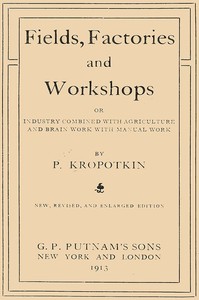
Fields, factories and workshops — Text and Context
(0 User reviews)
760
Project Gutenberg
2021
Not confirmed
Economics; Agriculture -- Economic aspects; Industries; Technical education
Readers of public-domain and historical texts
Project Gutenberg digital edition
en
Edition facts
Words
110,164
Reading time
479 min
Text sections
22
The catalog record for Fields, factories and workshops — Text and Context provides practical reading context through 110,164 words, 7 hr 59 min estimated reading time, and 22 detected text sections.
The text analysis averages about 26.9 words per sentence, while the detected sections provide another way to judge how the source is divided.
Project Gutenberg metadata also associates the work with “Economics,” connecting these edition facts with the source record’s subject description.
Source:
Project Gutenberg record #64353
Kropotkin's revised 1913 edition argues, using statistical data from France, Germany, and the UK, that industrial decentralization and the persistence of small-scale production challenge orthodox economic predictions of inevitable factory concentration.
Read the complete public-domain text at its original source.
Read on Project GutenbergKropotkin opens this revised edition by noting that fourteen years after the first edition, new statistical and descriptive materials allow him to verify his earlier predictions. He asserts that the tendency toward decentralization of industries has become more definite, with new nations entering world markets and freeing themselves from exploitation by more advanced industrial powers. The preface immediately establishes the book's method: using concrete data—factory censuses, trade figures, and agricultural reports—to challenge the orthodox economic narrative of inevitable large-scale concentration.
Statistical Grounds for Questioning Concentration
Kropotkin devotes considerable space to the lack of reliable data in the United Kingdom compared to France and Germany, which conducted periodic censuses of all factories and workshops. He criticizes economists for basing claims about industrial concentration on “mere impressions” rather than numbers. Drawing on the 1897 Factory Inspectors' Report, he presents a table showing 178,756 establishments employing 4,483,800 operatives, with an average of only 25 per establishment. Non-textile factories averaged 35 operatives, while workshops—defined as lacking mechanical motive power—averaged just 8. These figures, he argues, reveal a persistent small-scale sector that orthodox theory had declared doomed.
The Persistence of Petty Trades
Kropotkin observes that despite the obvious advantages of large factories in labor economy and access to raw materials, petty trades continue to thrive. He notes that even in the textile industry, where factory concentration might seem inevitable, one could see “immense barracks facing the streets by more than a hundred windows each” standing silent while hand-loom weavers worked in their homes for the same factory owners. He attributes this to the “spasmodic character of the trade” and the heavy losses when mills cannot run year-round. The silk trade, he adds, continues to spread across Europe in rural industry form, while hundreds of new small trades appear annually, often sheltering in city suburbs under the “sweating system.”
Method and Scope of the Inquiry
Kropotkin acknowledges the difficulty of covering the countless small industries in a single chapter. He states that when he began studying the subject thirty years earlier, he “never guessed… what a wide, complex, important, and interesting organisation would appear at the end of a closer inquiry.” He therefore limits himself to “a few typical illustrations” and the “chief lines” of the subject. This candid admission of the topic's breadth—and the insufficiency of orthodox economic categories to capture it—underscores his argument that the industrial landscape is far more varied than standard accounts suggest. His approach is to let the statistical and descriptive evidence speak, rather than to impose a theoretical framework.
Readers should note that this edition was revised in 1913, and Kropotkin explicitly uses the intervening fourteen years of data to test his earlier forecasts. The book is not a theoretical treatise but a detailed empirical argument, drawing on French, German, and British sources. Those interested in the history of economic thought or in alternative accounts of industrialization will find here a systematic challenge to the inevitability of large-scale factory production, grounded in the very numbers that orthodox economists claimed supported their case.
There’s something almost tender in Kropotkin’s stubborn numbers, insisting the small workshop survives the factory’s shadow. It reminds me of old notebooks, where another mind wrestled with Marx’s predictions, less sure of their iron logic. I keep returning to that quieter reckoning. Historical materialism and the economics of Karl Marx — Reading Notes feels like that same wistful skepticism, held gently.
There are no reviews for this eBook.
There are no comments for this eBook.
Reader reflection
How did this book work for you?
Your answers remain private and are stored only in this browser.
Your progress
0
/
10
2
How much did you enjoy the reading experience?
3
How likely are you to recommend this book?
4
Did the language feel accessible?
5
Which part made the strongest impression?
6
How useful were the ideas in this book?
7
How closely did the book connect with your experience?
8
Is this a title worth rereading?
9
What did this book teach you most?
10