1

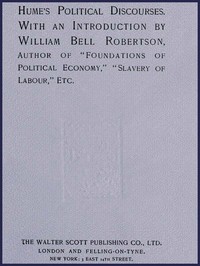
Hume's Political Discourses — A Closer Reading
(0 User reviews)
31
Project Gutenberg
2019
Not confirmed
Political science; Economics
Readers of public-domain and historical texts
Project Gutenberg digital edition
en
Edition facts
Words
107,902
Reading time
470 min
Text sections
48
Before opening Hume's Political Discourses — A Closer Reading, the edition data offers a quick orientation: 107,902 words, 7 hr 50 min estimated reading time, and 48 detected text sections.
The text analysis averages about 25.5 words per sentence, while the detected sections provide another way to judge how the source is divided.
Project Gutenberg metadata also associates the work with “Political science,” connecting these edition facts with the source record’s subject description.
Source:
Project Gutenberg record #59792
David Hume's 1752 Political Discourses, edited by William Bell Robertson, presents economic and political essays that examine commerce, money, balance of trade, and ancient populations. The opening excerpts show Hume's empirical method, using historical examples like Roman civil wars and Solon's laws to argue that excessive lenity in laws can breed cruelty.
Read the complete public-domain text at its original source.
Read on Project GutenbergDavid Hume's Political Discourses, first published in 1752 and here edited by William Bell Robertson, opens with an introduction that frames Hume primarily as a political economist. The table of contents lists twenty essays, ranging from 'Of Commerce' and 'Of Money' to 'Of the Populousness of Ancient Nations' and 'Idea of a Perfect Commonwealth.' The excerpts reveal a writer who grounds abstract arguments in concrete historical cases: Roman seditions, Solon's census laws, and the violence of the Gracchi era. Hume's prose is measured but pointed, as when he observes that 'excessive lenity in the laws naturally produces cruelty and barbarity.'
Hume's Comparative Method
The excerpts show Hume repeatedly testing political maxims against ancient and modern examples. In the passage on Roman civil wars, he notes that Appian's history 'contains the most frightful picture of massacres, proscriptions, and forfeitures that ever was presented to the world.' Hume contrasts this with the earlier Roman restraint, where 'no blood was ever shed in any sedition at Rome till the murder of the Gracchi.' He uses Dionysius of Halicarnassus's argument that Roman humanity proved Greek origins, only to undercut it by detailing later violence. This comparative approach—setting Athens against Rome, Solon's laws against Servius Tullius's—is a hallmark of the Discourses. Readers should watch how Hume moves from a specific historical observation to a general principle, often with a wry turn of phrase.
The Paradox of Lenity and Severity
A recurring thread in the excerpts is Hume's interest in unintended consequences. He argues that 'excessive severity in the laws is apt to beget great relaxation in their execution, so their excessive lenity naturally produces cruelty and barbarity.' The example of the late Roman republic, where capital punishments were abolished, leads party leaders to 'draw the sword of private vengeance.' Hume even speculates that Brutus, had he prevailed, could not have safely exiled Octavius and Anthony. This paradox—that mild laws can cause bloodshed—is presented without moralizing. Hume's tone is analytical, almost clinical, as he dissects the logic of political institutions. Readers may find this section especially provocative for its challenge to simple notions of legal reform.
Ancient Democracies and Exclusion
Hume examines the instability of ancient governments through the lens of citizenship and franchise. He observes that 'the very quality of freeman gave such a rank, being opposed to that of slave, that it seemed to entitle the possessor to every power and privilege of the commonwealth.' Solon's laws, which excluded no freeman from votes but limited some magistracies by census, still provoked discontent. When Antipater set a census of 2000 drachmas for voting, 'above two-thirds of them immediately left their country.' Even Cassander's reduction to half that census was seen as 'oligarchical tyranny.' Hume uses these episodes to illustrate the difficulty of establishing stable aristocracy in ancient times. The excerpts do not reveal his own preferred system, but the pattern of popular unrest is documented with care.
The Editor's Role and the Text's Provenance
William Bell Robertson's introduction, though only partially excerpted, sets the stage by quoting Lord Brougham's praise of the Political Discourses and noting that Hume's economic principles are 'set forth' in this collection. The editor also includes Hume's autobiographical 'My own Life' and Adam Smith's letter on Hume's death. Readers should note that this edition is part of 'The Scott Library' series, and the text was prepared from page images at the Internet Archive. The excerpts include extensive endnotes (e.g., note 67 on page 137) and an alphabetical list of authorities cited by Hume. This scholarly apparatus suggests the editor aimed to provide a reliable text for students of political economy. The provenance—a 2019 Project Gutenberg release—means the text is freely accessible but lacks modern annotation.
As you read the Political Discourses, pay attention to how Hume builds his arguments from specific historical cases rather than abstract principles. His tone is often ironic, and his conclusions may unsettle conventional wisdom. The essays are independent but share a method: test political maxims against experience. Robertson's edition provides a useful entry point, but the real value lies in Hume's own reasoning.
I’ve often lingered over Hume’s Political Discourses—how he watches the delicate balance of laws and temper, noting that too much lenity breeds cruelty. It reminds me of the quiet, patient notes in A rational wages system — Reading Notes, where another careful mind weighs fairness against human stubbornness. Both sit comfortably on my shelf, whispering the same old truth: we must measure before we mend.
There are no reviews for this eBook.
There are no comments for this eBook.
Reader reflection
Your personal reading reflection
Build a private reading journal entry for this title.
Your progress
0
/
10
2
What was your overall reaction to the book?
3
Would you recommend this book to another reader?
4
What was the reading difficulty like?
5
Did the book give you something worth debating?
6
Would you read this book again?
7
Was the book easy to understand?
8
How did the pace of the book feel?
9
In one sentence, what did you learn?
10