1

My Adventures with Your Money — Inside the Classic
(0 User reviews)
330
Project Gutenberg
2013
Not confirmed
Speculation; Mineral industries -- Finance
Readers of public-domain and historical texts
Project Gutenberg digital edition
en
Edition facts
Words
105,493
Reading time
459 min
Text sections
11
This digital edition of My Adventures with Your Money — Inside the Classic is described by source-level measurements including 105,493 words, 7 hr 39 min estimated reading time, and 11 detected text sections.
The text analysis averages about 18.9 words per sentence, while the detected sections provide another way to judge how the source is divided.
Project Gutenberg metadata also associates the work with “Speculation,” connecting these edition facts with the source record’s subject description.
Source:
Project Gutenberg record #44274
George Graham Rice's 1913 exposé of mining stock swindles, written by a convicted promoter who later turned informant. The book details the Nipissing, Goldfield, and Rawhide booms, naming financiers and journalists who manipulated markets and public opinion. Rice's insider perspective reveals how press agents, fake reports, and bribed officials separated speculators from their money.
Read the complete public-domain text at its original source.
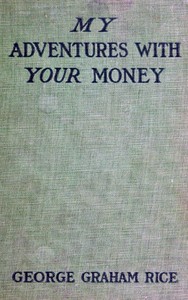
Read on Project GutenbergGeorge Graham Rice opens his 1913 memoir with a dedication 'To The American Damphool Speculator, surnamed the American Sucker,' setting a tone of sardonic confession. Rice, a convicted stock promoter, writes from the inside: he knows the machinery of mining fraud because he built it. The book's table of contents reads like a rogues' gallery—Maxim & Gay, Goldfield, Nipissing, Rawhide—each chapter a case study in how 'the public's money' was extracted through fake assays, paid-off journalists, and rigged stock exchanges.
Rice's voice is that of a man who has stopped pretending. He names names: W. B. Thompson, John Hays Hammond, the Guggenheims. He explains how a single favorable engineering report could inflate a worthless claim into a $75 million bubble. The excerpts show a writer obsessed with the gap between respectable finance and outright theft—a gap he insists is only a matter of degree.
The Anatomy of a 'Separation Scheme'
Rice devotes considerable space to the Nipissing mining campaign, which he calls a 'grand separation scheme' that extracted $75 million to $100 million from the public. He traces how the stock was promoted: a favorable report from a famous engineer, newspaper stories planted by press agents, and a steady drip of 'inside information' to brokers. The climax came when the report was revealed to be misleading—but by then, the insiders had sold.
Rice's key observation is that the scheme left almost no paper trail. 'Where does real tangible evidence of a conspiracy to defraud in Nipissing exist?' he asks, then answers: a diligent investigator could find it in newspaper files. He challenges the reader to look at the public record—the same records that showed the promoters' names, the timing of their sales, and the glowing articles that preceded each dump.
What makes Rice's account distinctive is his refusal to let the big names off the hook. He notes that the engineer who wrote the fatal report later became a special ambassador, a heavy Republican donor, and was 'talked of as running mate for Mr. Taft.' The implication is clear: the system protects those who play the game well.
Press Agents and the Manufacture of Belief
Rice devotes a chapter to 'The Press Agent and the Public's Money,' arguing that mining booms were built on publicity, not geology. He describes how promoters hired writers to produce 'hair-raising stories for distant readers'—tales of overnight fortunes, rich ore strikes, and eccentric prospectors. The goal was not to inform but to create a mood of excitement that would drown out skepticism.
One technique Rice highlights is the use of celebrity endorsements. He mentions Elinor Glyn, the novelist, and Nat. C. Goodwin, the actor, as figures whose names were borrowed to lend glamour to stock promotions. Another was the staged event: a funeral oration for a gambler named Riley Grannan, or a prize fight used to draw attention to a mining camp. Rice presents these as calculated moves in a game where the public's emotions were the only real ore.
The excerpts show Rice's contempt for the press that enabled this. He names newspapers that ran paid 'news' items without disclosure, and he implies that many financial journalists were on the take. His evidence is circumstantial but specific: the timing of articles, the identical language in different papers, the sudden silence when a promotion collapsed.
The Big Fellow vs. the Little Fellow
Rice repeatedly draws a contrast between the 'respectable multi-millionaire bankers' who run losing promotions and the small-time swindlers who end up in jail. His argument is that both use the same methods—false promises, manipulated markets, and the exploitation of greed—but the big operators are protected by their wealth and connections. 'The aim of each is to get the public's money,' he writes, 'and the big fellow is more dangerous by a hundred thousand degrees.'
This theme runs through the excerpts. Rice notes that the Nipissing promoters—men like W. B. Thompson and E. P. Earle—remained in control of their properties long after the crash. Some even returned to run new promotions. Meanwhile, the small speculators who bought at the top were wiped out. Rice's tone is bitter but precise: he does not call for reform so much as he documents the inequality of outcomes.
The book's structure reinforces this point. Each chapter follows a similar arc: a boom, a flood of publicity, a crash, and then a quiet redistribution of assets to the insiders. Rice's own role is ambiguous—he admits to being part of the system, but his memoir is an act of exposure. He offers no solution, only the warning that the game is rigged from the start.
Rice's memoir is best read as a primary document of early twentieth-century financial culture. His claims should be weighed against other sources—he was, after all, a convicted swindler writing to justify himself. But the specificity of his details, the names he names, and the mechanics he describes give the book a documentary value that transcends its author's motives. Readers interested in the history of speculation, press manipulation, or the origins of securities regulation will find here a vivid, if partisan, account of how the game was played.
Reading George Graham Rice’s confessions, I kept thinking how little the machinery of money changes—the same fever, the same borrowed confidence. It made me reach for A Tract on Monetary Reform — Context and Discussion, not for answers, but for that quieter Keynesian voice, as if both men were describing the same restless tide, one from the wreckage, one from the shore.
There are no reviews for this eBook.
There are no comments for this eBook.
Reader reflection
Your personal reading reflection
Build a private reading journal entry for this title.
Your progress
0
/
10
2
Did this book hold your interest?
3
Would you encourage someone else to read it?
4
Did the language feel accessible?
5
How useful were the ideas in this book?
6
How clearly were the main ideas presented?
7
How strong was your personal connection to the text?
8
Which element worked best for you?
9
What is the main idea you are taking away?
10