1

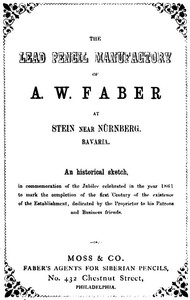
The Lead Pencil Manufactory of A. W. Faber at Stein near Nürnberg, Bavaria An Historical Sketch — Story, Setting & Ideas
(0 User reviews)
40
Project Gutenberg
2016
Not confirmed
Faber-Castell (Firm) -- History; Pencil industry -- Germany -- History
Readers of public-domain and historical texts
Project Gutenberg digital edition
en
Edition facts
Words
14,228
Reading time
62 min
Text sections
5
This digital edition of The Lead Pencil Manufactory of A. W. Faber at Stein near Nürnberg, Bavaria An Historical Sketch — Story, Setting & Ideas is described by source-level measurements including 14,228 words, 1 hr 2 min estimated reading time, and 5 detected text sections.
The text analysis averages about 28.2 words per sentence, while the detected sections provide another way to judge how the source is divided.
Project Gutenberg metadata also associates the work with “Faber-Castell (Firm) -- History,” connecting these edition facts with the source record’s subject description.
Source:
Project Gutenberg record #52256
A 1861 company history of A.W. Faber's pencil manufactory, detailing its century of operations, innovations in pencil grading, and legal battles against trademark infringement, based on the firm's own commemorative account.
Read the complete public-domain text at its original source.
Read on Project GutenbergThe Lead Pencil Manufactory of A. W. Faber at Stein near Nürnberg, Bavaria is a company-published historical sketch from 1861, marking the firm's first century. Rather than a neutral chronicle, it is a promotional document dedicated by the proprietor to his patrons and business friends. The text opens by asserting the lead pencil as a modern invention, contrasting it with classical and medieval writing tools, and quickly moves to celebrate the firm's achievements. The catalog subjects list pencil industry history, but the excerpts reveal a strong emphasis on trademark protection and quality claims, suggesting the work functions partly as a brand defense.
From Cumberland to Siberia: The Quest for Blacklead
The narrative traces the raw material supply chain with notable specificity. Early pencils relied on Cumberland blacklead, but as those mines depleted, the manufactory improved its manipulation of materials to produce multiple grades. The text claims its finest pencils surpassed Cumberland ones in hardness, firmness, and purity. A turning point arrives with the discovery of a new Siberian mine by Johann Peter Alibert, a merchant who explored river sands in the Oka, Belloi, Kitoi, and Irkutsk regions. The excerpts do not reveal the full outcome of this discovery, but the detailed geography underscores the global sourcing behind a seemingly simple product.
Grading the Line: A System of Hardness
A descriptive list inserted in the text catalogs Faber's Siberian lead pencils with a grading system ranging from BBBBBB (extra soft, extra black) to HHHHHH (extra hard). The grades are explicitly aimed at engineers, architects, artists, and wood engravers. This taxonomy—using B, HB, F, and H designations—is a precursor to modern pencil scales. The list also mentions artists' patent pencils with movable leads and boxes containing knives and rubbers, indicating the firm's attention to specialized markets. The precision of these grades reflects a manufacturing philosophy centered on standardization and customer specificity.
Counterfeits and Courtrooms: Defending the Trademark
A substantial portion of the excerpts details legal actions against counterfeiters. In New York, pencils with Faber's trademark and copied wrappers were imported by Winterhoff, Piper & Co., leading to a customs seizure and court prohibition. In Nürnberg, a deaf-mute lithographer named Georg Wolfgang Faber lent his name to a scheme exploiting the surname similarity; authorities revoked his license after proving he could not produce a serviceable pencil. A Fulda manufacturer who stamped “A. W. Faber” on over seven thousand dozen pencils was fined 50 thalers and sentenced to four weeks in prison, a verdict upheld on appeal. These cases show the firm actively policing its brand across jurisdictions.
Readers should approach this sketch as a primary source for nineteenth-century industrial branding and intellectual property enforcement, not as a comprehensive factory history. The excerpts reveal more about the firm's legal vigilance and marketing strategy than about daily operations or labor. The grading system and material sourcing details offer concrete evidence of technical evolution, but the celebratory tone warrants caution. Cross-referencing with external records would clarify how much of the narrative is factual versus aspirational.
That rain-soaked afternoon, I’d been tracing Faber’s fierce legal scrapes over counterfeit grading marks, and the sheer ingenuity of Victorian cheats stuck with me. Closing that century-old history, my fingers wandered to an odd little volume, Scamping Tricks and Odd Knowledge Occasionally Practised upon Public Works — Context and Discussion. There it was again—that same blend of admiration and unease for the clever, questionable hand.
There are no reviews for this eBook.
There are no comments for this eBook.
Reader reflection
Your personal reading reflection
Build a private reading journal entry for this title.
Your progress
0
/
10
2
Did this book hold your interest?
3
Is this a title you would suggest to others?
4
How much effort did this book require?
5
How distinctive were its ideas or approach?
6
How did the pace of the book feel?
7
Did you relate to its people, ideas, or situations?
8
Did the book deliver what you hoped for?
9
Which lesson or insight stayed with you?
10