1

The Livestock Producer and Armour — Text and Context
(0 User reviews)
1106
Project Gutenberg
2016
Not confirmed
Animal industry -- United States; Packing-house products
Readers of public-domain and historical texts
Project Gutenberg digital edition
en
Edition facts
Words
9,671
Reading time
43 min
Text sections
16
The source record for The Livestock Producer and Armour — Text and Context measures this digital text at 9,671 words, 43 min estimated reading time, and 16 detected text sections.
The text analysis averages about 24.9 words per sentence, while the detected sections provide another way to judge how the source is divided.
Project Gutenberg metadata also associates the work with “Animal industry -- United States,” connecting these edition facts with the source record’s subject description.
Source:
Project Gutenberg record #51244
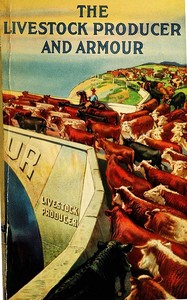
A 1920 corporate publication by Armour and Company defending the packing industry against accusations of price manipulation, using charts and internal accounting to argue that consumer demand, not packers, sets livestock prices.
Read the complete public-domain text at its original source.
Read on Project GutenbergThis 1920 volume, issued by Armour and Company, is not a neutral industry overview but a pointed defense of the packing business during a period of intense public scrutiny. The foreword, signed by J. Ogden Armour, frames the text as a response to “proposed radical legislation” and a “slump in American meat exports” that had shaken confidence in the livestock market. The book’s central argument—that packers do not control prices—is supported by charts, internal accounting examples, and a recurring analogy between packer by-product operations and a diversified farm.
The By-Product Argument as Corporate Insurance
The text devotes considerable space to explaining how by-product manufacturing offsets losses in meat departments. Each by-product unit—tannery, glue works, soap factory—must buy its raw materials “at prices ruling on the open market,” the same price an outside buyer would pay. This internal market discipline is presented as proof that no department is subsidized. The author likens this structure to a farmer who “diversifies his operations” so that a loss on cattle can be balanced by gains in lambs, wool, or eggs. The analogy is carefully chosen: it casts the packer as a prudent manager rather than a monopolist, and it implies that vertical integration is a form of risk management, not market control.
Consumer Demand as the Invisible Hand
A chart titled “What Makes the Price of Cattle” is the centerpiece of the argument that “America’s twenty million food shoppers” ultimately determine livestock prices. The text insists that the packer cannot say to the consumer, “You must buy meat and you must pay such and such a price.” Instead, the packer must “hedge” against losses by adjusting the price paid for cattle each day to match the price obtained for beef. Seasonal gluts of fish, poultry, or fruit are cited as external forces that depress beef demand and, in turn, cattle prices. The rhetoric is consistent: the packer is a passive intermediary, buffeted by forces beyond his control.
The Foreword’s Concession and Its Implications
The foreword reveals that Armour and Company had already agreed, “by a recent understanding with the Government,” to divest interests in stock yards and railway terminals, while retaining dairy and poultry operations. This concession is framed as “public service” and “enlightened self-interest,” but it also acknowledges that the company’s previous operations were seen as overreaching. The text’s defensive posture—its repeated insistence that packers operate on “small margins” and that “no array of proved facts” could convince critics—suggests that the intended audience includes not only livestock producers but also regulators and a skeptical public. The book is as much a political document as an economic one.
Readers should approach this text as a primary source in the history of American corporate public relations. The arguments it makes—about consumer sovereignty, the efficiency of large-scale distribution, and the necessity of by-product diversification—are still current in debates over food industry concentration. The charts and internal accounting details offer a rare window into how a major packer wanted to be seen, even if they do not settle the question of market power.
My grandfather kept his 1920 Armour booklet in a dusty cigar box, annotating its charts with pencil. Holding it, I remember his whisper: “Numbers always tell a story, but whose?” That same unsettled feeling returned years later, when I first turned the pages of Historical materialism and the economics of Karl Marx — Reading Notes. Both promised accounting, yet left me staring at my own reflection in the margins, wondering about the hand that drew the lines.
There are no reviews for this eBook.
There are no comments for this eBook.
Reader reflection
What did you think of this book?
Answer a few questions and save a private reflection on this device.
Your progress
0
/
10
2
How did the book work for you overall?
3
Would you pass this book on to a friend?
4
How demanding did the text feel?
5
How clearly were the main ideas presented?
6
How useful were the ideas in this book?
7
How well did it match your expectations?
8
How personally connected did you feel to the book?
9
Which lesson or insight stayed with you?
10