1

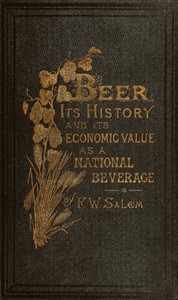
Beer, its history and its economic value as a national beverage — Story, Setting & Ideas
(0 User reviews)
1819
Project Gutenberg
2025
Not confirmed
Temperance; Beer -- History; Brewing industry -- United States -- History
Readers of public-domain and historical texts
Project Gutenberg digital edition
en
Edition facts
Words
62,074
Reading time
270 min
Text sections
30
The catalog record for Beer, its history and its economic value as a national beverage — Story, Setting & Ideas provides practical reading context through 62,074 words, 4 hr 30 min estimated reading time, and 30 detected text sections.
The text analysis averages about 13.8 words per sentence, while the detected sections provide another way to judge how the source is divided.
Project Gutenberg metadata also associates the work with “Temperance,” connecting these edition facts with the source record’s subject description.
Source:
Project Gutenberg record #76262
An 1880 temperance-advocacy work arguing that beer, especially lager, is a moderate alternative to distilled spirits, drawing on history, chemistry, and economic arguments. The author, F. W. Salem, dedicates the book to U.S. brewers and uses a firsthand observation of German beer gardens in Chicago to support his case.
Read the complete public-domain text at its original source.
Read on Project GutenbergF. W. Salem’s 1880 work opens with a dedication to the beer brewers of the United States, whom he calls “real, though perhaps unconscious, promoters of the great and glorious cause of genuine temperance.” This framing immediately signals that the book is not a neutral history but a polemic aimed at repositioning beer as a temperance beverage. The preface and early chapters promise to “expound the true nature and value of beer,” blending economic, historical, and moral arguments. Readers should note how Salem uses the authority of chemistry and statistics to counter the prevailing association of all alcohol with intemperance.
A Temperance Argument Rooted in Observation
The most vivid passage in the excerpts is Salem’s account of visiting German beer gardens in Chicago. He describes “a band of music, a dance floor, rude seats and tables like our New England picnics” and notes that “lager was the only beverage. No liquors, no drunkenness and no fights.” This scene becomes the empirical core of his argument: that beer, unlike distilled spirits, can be consumed in quantity without causing disorder. Salem contrasts this with his imagined outcome for “an American or Irish congregation” drinking whisky, which he predicts would result in “broken heads, bloody noses, and the wayside strewn with the wrecks of humanity.” The passage reveals how Salem uses ethnic stereotypes and personal observation to build a case for beer as a civilizing force.
The Chemistry of Moderation
Salem draws on chemical analysis to distinguish beer from spirits. He quotes A. Schwarz, editor of “Der Americanische Bierbrauer,” who argues that “among all drinks… lager beer especially commends itself by its properties.” The book includes an appendix of beer analyses, suggesting a reliance on scientific data to prove beer’s nutritional and mild intoxicating qualities. Salem also compares beer to tea, citing a physician who reports “tea sots” in an institution for the aged, exhibiting “increased mental irritability, muscular tremors and a greater or less degree of sleeplessness.” This parallel allows Salem to argue that even tea can be abused, while beer, properly consumed, is a wholesome alternative. The chemical lens is central to his strategy of reclassifying beer as a food rather than a drug.
Economic and Agricultural Justifications
Chapter IX, “Beer brewing a benefit to farmers,” indicates that Salem extends his argument beyond health to economics. The table of contents shows chapters on “The condition and prospects of the beer trade” and “Comparative advantages of Beer over distilled or spirituous liquors.” Salem likely argues that brewing supports agriculture by creating demand for barley and hops, and that a thriving beer industry reduces the market for hard liquor. The dedication to brewers and the inclusion of a list of brewers with production data (Appendix D) suggest the book also serves as a trade booster. Readers should watch how Salem weaves together moral reform and commercial interest, presenting temperance as compatible with—even dependent on—industrial growth.
Structure and Rhetorical Strategy
The book is organized into twelve chapters plus appendices, moving from ancient history to modern trade, then to comparative arguments and legal analysis. The early chapters (I–IV) cover beer’s history, while later chapters (VIII–XII) focus on temperance, prohibition, and expert testimony. This structure allows Salem to build a cumulative case: history shows beer’s ancient pedigree, chemistry proves its mildness, economics demonstrates its benefits, and authorities confirm its superiority. The appendices provide raw data—production figures, analyses, and brewery descriptions—that lend an air of objectivity. Readers should note how Salem uses footnotes and quotations from physicians and chemists to bolster his claims, even as his central argument remains a moral one about the dangers of distilled spirits.
Salem’s book is best approached as a period piece in the temperance literature, one that tries to carve out a middle ground between total abstinence and the hard-liquor trade. The excerpts show a writer who is earnest, observant, and willing to use anecdote alongside data. Readers interested in the history of American drinking culture, the rhetoric of temperance, or the economic arguments for beer will find this a rich, if partisan, source. The book’s dedication to brewers and its Chicago beer-garden scene are its most distinctive features.
That old beer book stayed with me—not for the arguments, but for how gently it trusted its reader to weigh history against habit. I found a similar quietness in Manual of References and Exercises in Economics for Use with Volume II. Modern Economic Problems — Edition Insights. It doesn’t push; it simply arranges ideas like windows left open, letting the morning air decide what’s worth remembering.
There are no reviews for this eBook.
There are no comments for this eBook.
Reader reflection
How will you remember this book?
Save your reaction, strongest insight, and memorable passage.
Your progress
0
/
10
2
How much did you enjoy the reading experience?
3
Is this a title you would suggest to others?
4
How easy was the book to follow?
5
How did the reading compare with what you expected?
6
Would you start a conversation about this book?
7
How clear did the writing feel?
8
Did anything about the book feel genuinely new?
9
What changed or sharpened your thinking?
10