1

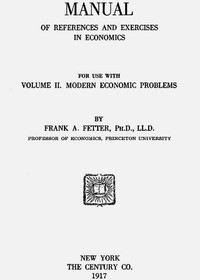
Manual of References and Exercises in Economics for Use with Volume II. Modern Economic Problems — Edition Insights
(0 User reviews)
236
Project Gutenberg
2013
Not confirmed
Economics -- Examinations, questions, etc.
Readers of public-domain and historical texts
Project Gutenberg digital edition
en
Edition facts
Words
19,722
Reading time
86 min
Text sections
3
The catalog record for Manual of References and Exercises in Economics for Use with Volume II. Modern Economic Problems — Edition Insights provides practical reading context through 19,722 words, 1 hr 26 min estimated reading time, and 3 detected text sections.
The text analysis averages about 12.0 words per sentence, while the detected sections provide another way to judge how the source is divided.
Project Gutenberg metadata also associates the work with “Economics -- Examinations, questions, etc.,” connecting these edition facts with the source record’s subject description.
Source:
Project Gutenberg record #41856
This manual supplements Fetter's 'Modern Economic Problems' with chapter-specific reference lists and exercises. The questions are designed to test comprehension and provoke critical thinking on topics like taxation, banking, and labor, reflecting early 20th-century economic debates.
Read the complete public-domain text at its original source.
Read on Project GutenbergFrank A. Fetter's Manual of References and Exercises in Economics for Use with Volume II. Modern Economic Problems (1917) is a pedagogical companion that mirrors the chapter structure of his textbook. Rather than offering narrative exposition, it presents curated bibliographies and a series of questions intended to guide student inquiry. The manual's voice is direct and instructional, with questions that often demand evaluative judgment—such as asking for the reader's own opinion on progressive taxation or the advisability of separating state and local revenues. This approach reflects Fetter's belief in active learning through problem-solving and critical engagement with contemporary economic issues.
Structure and Pedagogical Design
The manual is organized into 31 chapters, each corresponding to a chapter in Modern Economic Problems. Every chapter opens with a list of references—typically scholarly articles and books from the 1900s–1910s—followed by a set of questions. The references are not exhaustive; Fetter notes in the foreword that the literature is vast and he includes only a selection, often the more recent titles. The questions vary in type: some ask for definitions (e.g., “What is meant by the separation of state and local revenues?”), others for historical outlines (e.g., “Outline the history of income tax legislation by the federal government”), and many for critical analysis (e.g., “What is your judgment with reference to its advisability?”). This structure suggests that the manual was designed for classroom use, where students would read the references and then discuss or write answers to the questions.
Recurring Themes in the Questions
A striking feature of the questions is their focus on policy evaluation and practical application. For instance, in Chapter 17 on property and corporation taxes, students are asked to judge the advisability of separating state and local revenues and to identify defects in Massachusetts's method of taxing interstate railroads. In Chapter 18 on personal taxes, questions probe the justice of progressive taxation and the strongest arguments for and against it. The manual also frequently asks students to trace historical developments, such as the history of federal income tax legislation leading to the 1913 act. These recurring patterns indicate that Fetter aimed to develop students' ability to analyze real-world economic policies, not merely to memorize facts.
Voice and the Role of the Instructor
The manual's voice is that of a professor setting tasks: it uses second-person imperatives (“Discuss,” “Outline,” “Name”) and occasionally includes evaluative prompts (“What is your opinion?”). The questions are open-ended, inviting debate rather than single correct answers. For example, in Chapter 19 on industrial remuneration, a question asks students to discuss the statement that under piece-work the foreman looks out for quality and the operative for quantity, while under time-wage the roles reverse. This Socratic style positions the instructor as a facilitator, not a lecturer. The manual itself does not provide answers, reinforcing its role as a tool for active learning rather than a self-study guide.
Readers approaching this manual should treat it as a workbook that demands active participation. The references, though dated, offer a window into early 20th-century economic thought, while the questions remain relevant for practicing analytical skills. To get the most from this text, attempt to answer the questions using the cited sources or contemporary equivalents, and consider how the issues discussed—such as tariff policy, taxation, and labor remuneration—continue to resonate in modern economic debates.
That economics manual stayed with me not for its exercises, but for how it framed scarcity as a quiet pressure shaping daily choices. It reminded me of Fields, factories and workshops — Text and Context, where the same tension hums beneath every page—work, land, and the slow ache of resourcefulness. Some books don’t lecture; they just leave you noticing the weight of ordinary things.
There are no reviews for this eBook.
There are no comments for this eBook.
Reader reflection
How will you remember this book?
Save your reaction, strongest insight, and memorable passage.
Your progress
0
/
10
2
Was reading this book enjoyable?
3
How likely are you to recommend this book?
4
How demanding did the text feel?
5
Did this book create an emotional response?
6
How closely did the book connect with your experience?
7
How useful were the ideas in this book?
8
What did you think about the pace?
9
What did this book teach you most?
10