1

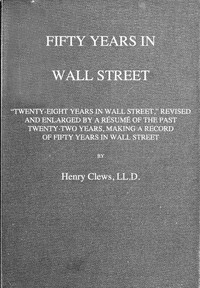
Fifty years in Wall Street — Inside the Classic
(0 User reviews)
741
Project Gutenberg
2023
Not confirmed
Business; Speculation; Capitalists and financiers -- United States; Wall Street (New York, N.Y.)
Readers of public-domain and historical texts
Project Gutenberg digital edition
en
Edition facts
Words
355,473
Reading time
1546 min
Text sections
102
For Fifty years in Wall Street — Inside the Classic, the stored edition analysis reports 355,473 words, 25 hr 46 min estimated reading time, and 102 detected text sections.
The text analysis averages about 23.2 words per sentence, while the detected sections provide another way to judge how the source is divided.
Project Gutenberg metadata also associates the work with “Business,” connecting these edition facts with the source record’s subject description.
Source:
Project Gutenberg record #70377
Henry Clews's firsthand account of five decades in Wall Street, covering panics, corners, and the financing of the Civil War, with detailed profiles of financiers like Astor and Vanderbilt.
Read the complete public-domain text at its original source.
Read on Project GutenbergHenry Clews opens his narrative not with a personal anecdote but with a declaration of purpose: to illuminate 'imperfectly known events connected with Wall Street speculations and investments' and to trace the financial progress of the United States over fifty years. The preface, dated March 31, 1908, positions the book as a revised and enlarged edition of his earlier 'Twenty-Eight Years in Wall Street,' extended by a résumé of the subsequent twenty-two years. Clews explicitly adopts the 'vernacular of the speculative fraternity' to render a 'plain, unvarnished tale,' signaling that the work will prioritize insider language over literary polish.
The Catalog Subject of 'Speculation' vs. Clews's Treatment
The catalog assigns 'Speculation' as a subject, and the excerpts confirm that Clews addresses it directly—but not as an abstract concept. In Chapter I, he traces the 'origin of “Corners”' and the sixty-day 'option' limit, grounding speculation in specific mechanisms. His preface, however, frames the book as a contribution to 'National history,' suggesting that speculation is inseparable from the country's financial development. The excerpts show Clews discussing the 'Panic of 1857' and the 'revolution in the methods of doing business' it caused, indicating that he treats speculation as a historical force rather than a moral failing. Notably, he defends Wall Street as a 'great distributor' in Chapter II, countering clerical criticism—a move that aligns with his stated aim to correct popular delusions.
Wealth and Its Disposition: A Chapter on Philanthropy and Eccentricity
Chapter XLVIII, 'Large Fortunes and Their Disposition,' reveals Clews's interest in how financiers managed their wealth after accumulation. He profiles John Jacob Astor, George Peabody, Johns Hopkins, A. T. Stewart, Stephen Girard, James Lenox, Peter Cooper, Samuel J. Tilden, and others, mixing biographical sketch with commentary on their philanthropic choices. The chapter's structure—a series of short portraits—suggests that Clews views fortune-building as a moral narrative. He notes that Astor left $400,000 to the Astor Library, while Girard's 'penurious habits' contrasted with his 'great donations.' These details align with the catalog subject 'Capitalists and financiers—United States,' but the excerpts show Clews focusing on the disposition of wealth rather than its accumulation, hinting at a didactic purpose: to model how fortunes should be used.
The Statue of Liberty as a Financial Symbol
In a striking digression, Clews interprets the Statue of Liberty as a 'panacea for all their ills' for the 'politically afflicted and oppressed' arriving in New York Harbor. He defends the statue's name against charges of American egotism, attributing it to Bartholdi himself. This passage, embedded in a financial memoir, illustrates Clews's tendency to weave patriotic and symbolic commentary into his economic narrative. The statue becomes a metaphor for the opportunities Wall Street represents—a theme that connects to the catalog subject 'Wall Street (New York, N.Y.)' but extends beyond finance into national identity. Clews's prediction that 'results will fully justify the assumption' by the century's close reveals his confidence in America's global role, a perspective that colors his financial observations.
Clews's memoir is best approached as a primary source for the self-perception of a Gilded Age financier. Readers should note that the excerpts cover only the preface, table of contents, and two chapters; the bulk of the 355,473-word text remains unexamined. The work's value lies not in objective history but in Clews's insider perspective, his defense of speculation, and his moralizing on wealth. Those interested in the mechanics of 19th-century finance will find detailed accounts of panics and corners, while readers of social history may focus on his portraits of fellow capitalists and his patriotic asides.
Clews watched fortunes rise and vanish like foam on a glass, yet he always noted the steady hands behind the speculation. There's a similar quiet honesty in the old brewer’s account of his craft—not glamorous, just true. Both books sit in my memory as patient witnesses to what really sustains a nation. I often think of them together. Beer, its history and its economic value as a national beverage — Story, Setting & Ideas shares that same unhurried, plainspoken dignity.
There are no reviews for this eBook.
There are no comments for this eBook.
Reader reflection
Your personal reading reflection
Build a private reading journal entry for this title.
Your progress
0
/
10
2
Did this book hold your interest?
3
Would you recommend this book to another reader?
4
What was the reading difficulty like?
5
Do you expect to return to this book?
6
How closely did the book connect with your experience?
7
Did you gain anything practical from the text?
8
How would you describe its reading pace?
9
In one sentence, what did you learn?
10