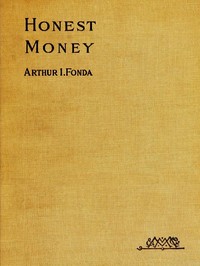
Arthur I. Fonda opens Honest Money with a stark observation: the United States, despite abundant resources and an industrious population, suffers periodic depressions where capital and labor cannot find employment while warehouses and granaries overflow. This paradox, he contends, points not to accident but to a fault in the economic system—specifically, the monetary system. Published in 1895, the work emerges from a magazine article and aims to give fuller treatment to the idea of a perfect money. Fonda positions himself against defenders of the gold standard, engaging directly with figures like David A. Wells and invoking authorities such as Ricardo and John Stuart Mill.
A Paradox of Plenty and Want
Fonda’s preface sets up a recurring tension: the country is rich in “necessaries and most of the luxuries of life,” nature is bounteous, the population enterprising—yet large numbers cannot find work. He describes warehouses filled with manufactured goods and barns bursting with food products while men suffer for the necessities of life. This condition, he insists, is “as wrong as it is unnecessary.” The periodic recurrence of such crises, extending to other countries, suggests a general cause, and Fonda points to the monetary system as the chief source. He acknowledges other contributing factors but argues that none alone can account for the great fluctuations. The language is direct and diagnostic, framing the book as a response to a pressing national problem.
Critique of the Gold Standard and the Ghost of Mercantilism
In Chapter VI, Fonda takes aim at the notion that international trade requires a gold basis. He dismisses the idea that a country must hold gold to settle trade balances, calling it a relic of the old “mercantile theory” buried by Adam Smith a century ago—yet its ghost still stalks. He argues that gold moves only when its value is lower in the exporting country than in the importing country, by more than the cost of shipment. The common expressions “balance of trade in favour of” or “against a country” are, he says, misleading; they merely indicate that gold is being imported or exported for profit, not that the country is prosperous or distressed. Fonda insists that under a sound monetary system, the export or import of gold would be no more significant than that of corn or silk.
The Case for a Stable Standard
Fonda’s central argument hinges on the definition of value. He sides with Ricardo, Mill, and other authorities who hold that the value of a commodity is its general purchasing power. Against this, he positions the views of gold-standard defenders like Mr. Wells, whom he accuses of fundamental and dangerous errors. The goal of a perfect money, as sketched in the preface, is to maintain constant average prices—a condition that would render gold movements economically neutral. Fonda’s tone is combative but scholarly, quoting and critiquing opponents while building a case for a monetary system divorced from metal. The excerpts do not reveal his full proposal, but the pattern is clear: he seeks to replace what he sees as a flawed, crisis-prone system with one based on stable purchasing power.
Readers should note that Fonda writes from the midst of the 1890s depression, a context that sharpens his urgency. His arguments are directed at policymakers and the educated public, assuming familiarity with classical economists. The excerpts show a writer who values logical precision and historical precedent, but they do not disclose his final prescription. Approach the book as a period piece in monetary theory, one that challenges both the gold standard and the then-dominant mercantile assumptions about trade.
Reading Honest Money, I kept thinking about the quiet desperation Fonda described—that sense of a system quietly slipping wrong, dragging good people with it. It felt familiar, reminding me of the same slow unraveling told from inside those wrecked schemes in My Adventures with Your Money — Inside the Classic. Both felt like letters from another era, whispering about money’s strange, human weight.