1

How to conduct a small mail order business — Text and Context
(0 User reviews)
722
Project Gutenberg
2023
Not confirmed
Mail-order business
Readers of public-domain and historical texts
Project Gutenberg digital edition
en
Edition facts
Words
6,163
Reading time
27 min
Text sections
32
The catalog record for How to conduct a small mail order business — Text and Context provides practical reading context through 6,163 words, 27 min estimated reading time, and 32 detected text sections.
The text analysis averages about 18.8 words per sentence, while the detected sections provide another way to judge how the source is divided.
Project Gutenberg metadata also associates the work with “Mail-order business,” connecting these edition facts with the source record’s subject description.
Source:
Project Gutenberg record #71267
This 1896 guide advises on starting a small mail-order business, contrasting staple goods with novelties and emphasizing the importance of attractive products and proper advertising. It includes practical hints and humorous anecdotes, reflecting the era's postal commerce.
Read the complete public-domain text at its original source.
Read on Project GutenbergW. E. Skinner's 1896 pamphlet opens by situating mail-order trade within a rapidly expanding postal system, noting that "the ranchman on the plains may wear a latest style metropolitan custom-made suit" through catalog shopping. The author immediately distinguishes between staple goods—which offer thin margins for small operators—and novelties, where lighter, less breakable items like toys and books can sell in quantity if advertised in November and December. This practical dichotomy frames the entire guide.
Starting with the Right Article
Skinner devotes early pages to the fundamental choice between staples and novelties. Staple goods, he argues, are already available from local retailers, so customers rarely mail-order them unless they are branded specialties like "Plymouth Rock Pants" or "Douglas’ Shoes." Even then, manufacturers told him there is "no profit in the mail orders"—such sales merely popularize the brand. The exception is watches, silverware, and jewelry, which remain strong mail-order sellers. Novelties, by contrast, offer hundreds of possibilities: books, toys, games, photographs, and perfumery. The key is to select items that are light, hard to break, and timed for seasonal demand.
The Role of Advertising and Presentation
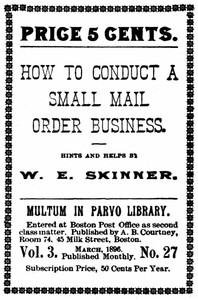
While the excerpts do not reproduce the full advertising advice, the pamphlet repeatedly stresses that "the advertisement must be properly arranged." Skinner implies that even a good product will fail without an eye-catching description and proper placement. The guide's own title page—priced at five cents and part of the "Multum in Parvo Library"—models the concise, value-oriented pitch he recommends. Readers are urged to study successful catalog copy and to test small ads before committing larger sums.
Humor as a Window into 1890s Commerce
The later excerpts shift abruptly to jokes and anecdotes, such as the Irish stablehand who hitched the wrong horse, or the mother who whipped her child at the photographer's for not smiling. These appear to fill space but also reflect the era's expectation that a business pamphlet should entertain. The jokes are not directly about mail order, but they reveal the cultural context: a readership comfortable with dialect humor, domestic scenes, and mild social satire. Skinner likely included them to keep the booklet light and memorable.
Structure and Limitations of the Text
At roughly 6,000 words, the pamphlet is a concise primer, not a comprehensive manual. The excerpts show that after the initial advice on product selection and advertising, the text becomes a miscellany of filler material—jokes, transcribed jokes, and possibly reprinted filler from periodicals. The transcriber's notes indicate that two words were illegible in the original print, suggesting the source was a cheaply produced booklet. Readers should therefore treat the later sections as period flavor rather than actionable business guidance.
Skinner's pamphlet is best read as a historical artifact of 1890s small-enterprise culture. Its core advice—choose novelties over staples, advertise seasonally, and keep packaging light—remains sensible, but the humorous filler and lack of detailed financial planning limit its practical use today. Approach it as a snapshot of how mail-order pioneers thought about their trade, not as a step-by-step manual.
I remember that little mail-order handbook, so certain that attractive wares would find their buyers. Yet years later, my eye fell upon Progress and Poverty, Volumes I and II An Inquiry into the Cause of Industrial Depressions and of Increase of Want with Increase of Wealth — Text and Context, and I thought how even the cleverest catalog must answer to the deeper, silent economics between folks.
There are no reviews for this eBook.
There are no comments for this eBook.
Reader reflection
How did this book work for you?
Your answers remain private and are stored only in this browser.
Your progress
0
/
10
2
What was your overall reaction to the book?
3
How likely are you to recommend this book?
4
How much effort did this book require?
5
How well did it match your expectations?
6
Could you follow the author’s main argument?
7
Which element worked best for you?
8
Did you relate to its people, ideas, or situations?
9
What is the main idea you are taking away?
10