1

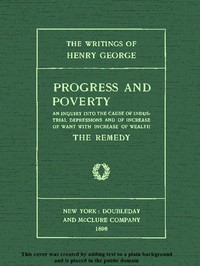
Progress and Poverty, Volumes I and II An Inquiry into the Cause of Industrial Depressions and of Increase of Want with Increase of Wealth — Text and Context
(0 User reviews)
1131
Project Gutenberg
2017
Not confirmed
Economics; Single tax
Readers of public-domain and historical texts
Project Gutenberg digital edition
en
Edition facts
Words
181,646
Reading time
790 min
Text sections
64
The source record for Progress and Poverty, Volumes I and II An Inquiry into the Cause of Industrial Depressions and of Increase of Want with Increase of Wealth — Text and Context measures this digital text at 181,646 words, 13 hr 10 min estimated reading time, and 64 detected text sections.
The text analysis averages about 31.3 words per sentence, while the detected sections provide another way to judge how the source is divided.
Project Gutenberg metadata also associates the work with “Economics,” connecting these edition facts with the source record’s subject description.
Source:
Project Gutenberg record #55308
Henry George's 1879 inquiry into why poverty persists alongside material progress, arguing that land monopoly is the root cause of industrial depressions and inequality, with a proposed remedy of a single tax on land values.
Read the complete public-domain text at its original source.
Read on Project GutenbergHenry George opens Progress and Poverty with an epigraph from Marcus Aurelius, urging the reader to examine things "in its substance, in its nudity, in its complete entirety." This call for clear-sighted analysis sets the tone for a work that aims to strip away what George calls "elaborate fallacies and misleading theories" obscuring the cause of industrial depressions. The book is structured as a sustained argument: Book VI, titled "The Remedy," signals that diagnosis will lead to prescription. George's preface to the fourth edition states that the core idea was first sketched in an 1871 pamphlet, "Our Land and Land Policy," and that he became "even more firmly convinced of its truth" over time. The text repeatedly insists that the problem is not in the relations of capital and labor nor in population pressure, but in the unequal ownership of land.
The Central Claim: Land Monopoly as Root Cause
George's argument hinges on a single proposition: "The great cause of inequality in the distribution of wealth is inequality in the ownership of land." He grounds this in the physical necessity of land for all production—"for even the products of the sea cannot be taken, the light of the sun enjoyed, or any of the forces of nature utilized, without the use of land or its products." Material progress, he contends, cannot free humanity from this dependence; it only increases the value of land and the power of its owners. The preface explicitly rejects competing explanations, stating that the cause is not found "in the relations of capital and labor" or "in the pressure of population against subsistence." Instead, George insists that land ownership is "the great fundamental fact which ultimately determines the social, the political, and consequently the intellectual and moral condition of a people." This sweeping claim is supported by a rhetorical strategy that contrasts the simplicity of the truth with the complexity of the fallacies that obscure it.
Rhetorical Structure and Persuasive Strategy
George employs a distinctive persuasive method, comparing his central insight to a hidden picture in a "confused labyrinth of lines" that, once seen, becomes permanently clear. He writes: "This relation once recognized, is always afterward clear." The book's structure mirrors this revelatory logic: it first diagnoses the problem (Books I–V) and then proposes the remedy (Book VI). The epigraphs from De Tocqueville and John Stuart Mill in Book VI emphasize that "small means do not merely produce small effects; they produce no effect at all," preparing the reader for a radical solution. George also anticipates opposition by naming "an active, energetic power" that "writes laws and molds thought—the power of a vast and dominant pecuniary interest." This framing positions the work as an exposure of interests that benefit from obscuring the truth. The prose is direct and declarative, often using parallel constructions and biblical cadences, as in "On the land we are born, from it we live, to it we return again."
The Proposed Remedy and Its Implications
Book VI, titled "The Remedy," opens with a chapter on the "Insufficiency of Remedies Currently Advocated" before presenting "The True Remedy." While the excerpts do not detail the remedy itself, the catalog subject "Single tax" and the subtitle's reference to "The Remedy" indicate that George advocates a tax on land values as the solution. The preface frames this as a truth "so simple and so clear" that once fully seen, it is always recognized. George's argument implies that existing economic theories are not merely mistaken but actively harmful, as they lead people to "look in every direction but the right one." The remedy is presented as a structural change that would address the root cause of industrial depressions and the paradox of "increase of want with increase of wealth." The book's dedication—"To those who, seeing the vice and misery that spring from the unequal distribution of wealth and privilege, feel the possibility of a higher social state and would strive for its attainment"—reveals George's intended audience: reformers seeking a practical path to social improvement.
Readers approaching Progress and Poverty should attend to how George builds his case from physical first principles—land as the necessary condition of all production—to a sweeping critique of industrial society. The book rewards attention to its rhetorical architecture: the way George contrasts simplicity with complexity, the use of epigraphs to frame chapters, and the repeated insistence that the truth is hidden by powerful interests. The work is best read as a sustained argument rather than a reference text; its force lies in the cumulative logic of its diagnosis and the boldness of its proposed cure.
Reading Progress and Poverty felt like watching someone quietly remove a stone from a wall — suddenly the whole structure shifted. That same unsettling clarity stays with me in My Adventures with Your Money — Inside the Classic, where money’s promises unravel into something simpler and stranger. Some books don’t argue with you; they just wait, patiently, until you see what they saw.
There are no reviews for this eBook.
There are no comments for this eBook.
Reader reflection
How will you remember this book?
Save your reaction, strongest insight, and memorable passage.
Your progress
0
/
10
2
How much did you enjoy the reading experience?
3
Is this a title you would suggest to others?
4
How demanding did the text feel?
5
Was the book moving at the right speed?
6
Did the book offer a fresh perspective?
7
Could you apply anything you learned?
8
Did the book meet your expectations?
9
Which lesson or insight stayed with you?
10