About 290 minutes
Scamping Tricks and Odd Knowledge Occasionally Practised upon Public Works — Context and Discussion
Economics
66,636 recorded words. 5 minutes difference from this book's estimate.
View Gutenberg source #34942
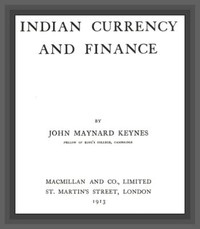
Indian Currency and Finance — Context and Discussion can be approached with a clearer sense of reading commitment from its source measurements: 67,671 words, 4 hr 55 min estimated reading time, and 17 detected text sections.
The text analysis averages about 24.6 words per sentence, while the detected sections provide another way to judge how the source is divided.
Project Gutenberg metadata also associates the work with “Precious metals,” connecting these edition facts with the source record’s subject description.
Explore this collection
These alternatives are selected using recorded categories and estimated reading time.
About 290 minutes
Economics
66,636 recorded words. 5 minutes difference from this book's estimate.
View Gutenberg source #34942About 270 minutes
Economics
62,074 recorded words. 25 minutes difference from this book's estimate.
View Gutenberg source #76262About 263 minutes
Economics
60,424 recorded words. 32 minutes difference from this book's estimate.
View Gutenberg source #58204Search stored excerpts and compare books → Choose by your preferences →
Choices use stored catalog measurements. Estimates vary with reading speed. A shared category is a catalog label, not a claim that two books have the same argument or literary quality.
Search reads excerpt text stored with this catalog and links to its associated Gutenberg record. The connection is stored in the site database; this tool does not recheck that every excerpt is word-for-word identical to that external record. Excerpt search does not cover every chapter and does not verify historical publication dates.
Catalog snapshot checked: 2026-09-25. Coverage: 100 public books, 100 available source excerpts.
Read the complete public-domain text at its original source.
Read on Project GutenbergKeynes opens Indian Currency and Finance by declining to rehearse 'broad historical facts,' instead focusing on the mechanics of the rupee's stabilization after the 1893 closure of mints to silver. He notes that by 1899 the rupee had been fixed at 1s. 4d., a rate maintained 'without sensible variation' since. This brisk, technical start signals that the book is not a general history but an examination of how the system actually works—and where it might fail.
The preface, dated May 1913, reveals that Keynes had accepted a seat on the Royal Commission on Indian Finance and Currency while the book was already in type. He decided to publish without waiting for the Commission's report, so the text represents his views formed independently of that official process. Readers should note that the book is 'wholly prior in date to the labours of the Commission,' making it a pre-commission snapshot of Keynes's thinking.
Chapter I establishes the central puzzle: how did India maintain the rupee at 1s. 4d. after abandoning free silver coinage? Keynes describes the pre-1893 system as one where the rupee's gold value fluctuated with silver bullion, inconveniencing trade and disturbing public finance because of large sterling payments. The closure of mints 'divorced' the rupee's value from its metal content. By 1899, the government had succeeded in raising and holding the rate. Keynes does not treat this as a settled success; instead, he implies that the mechanism required constant management. The phrase 'without sensible variation' is carefully chosen—it suggests stability in practice, not in principle. Readers should watch for how Keynes later questions whether the reserves held to support this system are adequate for broader financial emergencies.
In a later excerpt, Keynes dives into the technical problem of measuring how many rupees are actually in circulation. He describes an annual census of rupees taken since 1875, examining bags of 2,000 coins in each Government Treasury. This allowed Comptrollers of Currency to apply 'the Jevonian method'—a statistical technique for estimating total coinage from sample proportions. Keynes notes that Mr. F. C. Harrison and later Mr. Adie used increasingly complex methods, but he also flags a potential bias: the samples may overrepresent recent issues because older coins tend to be hoarded and move less. 'Since these samples are likely, therefore, to contain an undue proportion of recent issues, estimates of the total circulation, which are based on them, may be expected to fall short of the truth.' This caution reveals Keynes's critical eye for data quality, a theme that runs through the book.
Keynes poses a sharp question: should the government's sterling reserves be held merely to support the currency, or also to act as a banking reserve ensuring India can meet international obligations? He argues that the answer determines the necessary size of the reserve. If only for currency, the maximum volume of rupees and notes that could be 'spared from the circulation' sets an upper limit. But if it is to cover adverse trade balances, the limit is set by 'the probable maximum amount of the adverse balance which could arise against India for immediate payment.' This distinction is central to Keynes's analysis. He first examines the currency-only hypothesis, then promises to return to the broader problem. The structure of the argument—hypothesis, evidence, then expansion—is typical of his method. Readers should note that the excerpts do not reveal his final conclusion, only the framework he builds.
Keynes's treatment of the rupee census shows his respect for quantitative methods but also his awareness of their pitfalls. He describes how officials sometimes failed to examine samples conscientiously: 'A tendency was noticed for the returns of one year to resemble those of the previous year more closely than they should.' He also notes that coins were occasionally attributed to a year in which none were minted. These asides humanize the statistical process and remind the reader that even careful calculations rest on imperfect data. The book thus offers not just conclusions but a model of how to reason about monetary systems—testing assumptions, checking for bias, and distinguishing between what can be known and what must be guessed. For a first reading, paying attention to these methodological notes will enrich understanding of Keynes's later, more famous works.
Indian Currency and Finance is best approached as a technical monograph, not a general introduction. Keynes assumes familiarity with terms like 'bimetallism' and 'gold-exchange standard,' and he moves quickly from historical summary to statistical analysis. Readers new to the subject may benefit from first consulting a primer on Indian monetary history. The book's value lies in its detailed examination of how a colonial currency system actually operated—and in the early signs of Keynes's characteristic blend of theoretical clarity and practical skepticism.
That rainy afternoon, Keynes’s careful tables on Indian sterling reserves felt less like economics, more like quiet architecture. His insistence on orderly systems lingered, and by evening I found myself pulling an old pamphlet from the shelf, A rational wages system — Reading Notes, noticing how the same patient desire for fairness hums beneath both.
Your answers remain private and are stored only in this browser.