1

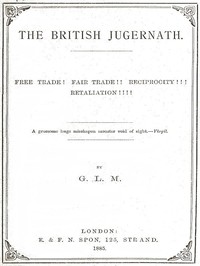
The British Jugernath: Free trade! Fair trade!! Reciprocity!!! Retaliation!!!! — A Reader’s Guide
(0 User reviews)
600
Project Gutenberg
2017
Not confirmed
Free trade; Tariff; Protectionism; Reciprocity (Commerce)
Readers of public-domain and historical texts
Project Gutenberg digital edition
en
Edition facts
Words
33,027
Reading time
144 min
Text sections
6
For The British Jugernath: Free trade! Fair trade!! Reciprocity!!! Retaliation!!!! — A Reader’s Guide, the stored edition analysis reports 33,027 words, 2 hr 24 min estimated reading time, and 6 detected text sections.
The text analysis averages about 21.1 words per sentence, while the detected sections provide another way to judge how the source is divided.
Project Gutenberg metadata also associates the work with “Free trade,” connecting these edition facts with the source record’s subject description.
Source:
Project Gutenberg record #55493
An 1885 polemic against British free-trade policy, using the metaphor of a monstrous Juggernaut to argue for protective tariffs, with specific proposals for taxing foreign wheat and critiques of political figures like Gladstone and Bright.
Read the complete public-domain text at its original source.
Read on Project GutenbergMolesworth opens his 1885 pamphlet with a Virgil epigraph describing a 'gruesome huge misshapen monster void of sight,' immediately casting free trade as a blind, destructive force. The title's escalating punctuation—'Free trade! Fair trade!! Reciprocity!!! Retaliation!!!!'—signals a rhetorical strategy of intensification. The preface to the second edition frames the work as a 'squib' written in 1883, warning of 'suicidal policy' and claiming that 'the evils indicated therein have greatly increased in intensity.' Molesworth targets specific opponents: he names Mr. Giffen's 'plausible statistics' and Mr. Bright's 'peevish denunciations,' and proposes a 'light tax on foreign wheat' that he calculates could enrich Britain and its dependencies by £60,000,000 annually.
The Juggernaut Metaphor and Structure
The work is organized into 26 short chapters, each with a title that sustains the Juggernaut conceit: 'To the Votaries of Jugernāth,' 'What is Jugernāth?,' 'False Prophets of Jugernāth,' 'The wages of Jugernāth,' and 'Ireland under the wheels.' This structure frames free-trade advocates as a cult and their policies as a sacrificial vehicle. The index shows that Molesworth moves from defining the monster to presenting 'a few ugly Facts,' then to axioms, political economy, and specific consequences like pauperism, crime, and intemperance. The chapter 'Selections from Jugernāth’s Sacred Writings' suggests he parodies free-trade texts as scripture. The recurring spelling 'Jugernāth' (with a macron) gives the term an exotic, archaic flavor, distancing it from the standard 'Juggernaut' and emphasizing its foreign, idolatrous nature.
Economic Arguments and the Land Question
Molesworth's economic reasoning is grounded in the landlord-tenant relationship. He quotes approvingly from an unnamed source (likely Bonamy Price) that 'rent is a simple debt' and that refusing to pay it 'is to steal.' He then applies this logic to criticize the government: 'Mr. Gladstone represents Government. Messrs. Bright, Parnell, Davitt and Co. assist in this legalized and illegal plunder.' The passage reveals a central tension: Molesworth defends property rights against what he sees as state-sanctioned theft, yet his own proposal for a wheat tax would intervene in markets. He cites Adam Smith on merchants and manufacturers having 'superior knowledge of their own interest' to persuade country gentlemen, applying this to free trade. The footnotes show he draws on classical economists selectively, using Smith against free-trade policies.
Rhetorical Tactics and Target Audience
The pamphlet employs a conversational, sometimes sarcastic tone. In the excerpt, Molesworth writes, 'Stop! Stop!! for goodness’ sake!!! My brain is getting confused,' feigning bewilderment at the logic of his opponents. He directly addresses the reader as 'pardon me, I am a little obtuse,' creating a persona of the honest, confused everyman. The target audience appears to be working men: the preface states that 'Working men who are unable to obtain employment can no longer be persuaded... that, thanks to Free Trade, they are better off.' Molesworth appeals to their immediate concerns—'Cheap food is of little avail if the means of purchasing it be not forthcoming'—rather than abstract theory. The price of sixpence and the short chapter lengths suggest an intent to reach a broad, non-specialist readership.
Readers should note that Molesworth's evidence is selective and his tone polemical. The excerpts show he uses quotation and footnote to build authority, but his argument relies on a chain of analogies (Juggernaut, vampire, false prophets) rather than systematic data. The work is best approached as a specimen of late-Victorian protectionist rhetoric, revealing how economic policy was debated through moral and religious imagery. The catalog subjects—Free trade, Tariff, Protectionism, Reciprocity—are all directly addressed, but the book's force lies in its satirical framing, not its economic originality.
There’s something almost sorrowful in watching an empire convince itself that fairness means keeping the gates open, while the British Juggernaut rolls on. I found myself thinking of that old argument when I picked up the Supplement to Commerce Reports Daily Consular and Trade Reports: Turkey, Harput — A Reader’s Guide, a quieter ledger of distant lives caught in the same machinery. Trade was never just numbers—it was always someone’s wheat, someone’s waiting.
There are no reviews for this eBook.
There are no comments for this eBook.
Reader reflection
What did you think of this book?
Answer a few questions and save a private reflection on this device.
Your progress
0
/
10
2
How did the book work for you overall?
3
Is this a title you would suggest to others?
4
How easy was the book to follow?
5
Was the book moving at the right speed?
6
How would you rate its originality?
7
How strongly did the book affect you emotionally?
8
Could you follow the author’s main argument?
9
What did this book teach you most?
10