1

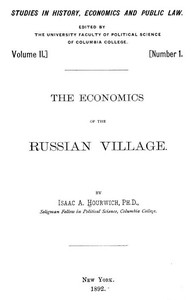
The Economics of the Russian Village — A Reader’s Guide
(0 User reviews)
392
Project Gutenberg
2015
Not confirmed
Thesis (Ph. D.); Peasants; Land tenure -- Russia; Mir; Agricultural laborers -- Russia
Readers of public-domain and historical texts
Project Gutenberg digital edition
en
Edition facts
Words
50,577
Reading time
220 min
Text sections
12
For The Economics of the Russian Village — A Reader’s Guide, the stored edition analysis reports 50,577 words, 3 hr 40 min estimated reading time, and 12 detected text sections.
The text analysis averages about 15.1 words per sentence, while the detected sections provide another way to judge how the source is divided.
Project Gutenberg metadata also associates the work with “Thesis (Ph. D.),” connecting these edition facts with the source record’s subject description.
Source:
Project Gutenberg record #50023
An 1892 Columbia dissertation examining post-emancipation Russian peasant economy through taxation, communal land tenure, and the dissolution of the mir, using statistical budgets and legal analysis.
Read the complete public-domain text at its original source.
Read on Project GutenbergHourwich opens with a blunt claim: the Russian village community, once upheld by economic equality, now oppresses both the destitute and the wealthy. The excerpts show a work grounded in legal statutes—like Section 165 of the General Statute of the Peasants—and in quantitative data, such as amortization taxes and land values. Rather than a general history, this is a focused economic argument: the mir is dissolving from within, driven by rising rent and individual interests.
Taxation as the Engine of Communal Pressure
The catalog subject Taxation is central, but the excerpts reveal a specific mechanism: the redemption tax paid by former serfs, assessed per capita, created arrears that bore directly on livestock. Hourwich writes that the fiscal system was “lived down by economic development,” implying that taxes originally designed to bind peasants to the mir instead accelerated inequality. He notes that the capitalized amortization tax initially exceeded land value, making redemption rare; only after twenty years did rising rent make speculative purchases feasible. This is not a dry fiscal history—it is a causal argument about how state policy inadvertently fueled class differentiation within the village.
The Mir as a Contested Institution
Catalog subjects list Mir and Land tenure, but the excerpts show Hourwich treating the commune not as a static relic but as a site of conflict. He describes “agrarian communism” with shares fixed in perpetuity evolving into periodic redivisions, and notes that wealthy peasants sometimes threatened to pay off the amortization debt to force the community to deed them their plots outright. The phrase “the ides of March are not gone” signals his view that the tension between communal rights and individual property is unresolved. He explicitly states that the old peasant common law, once natural under economic equality, now harms both the destitute and the wealthy—a precise observation traceable to the text’s own wording.
Dissolution from Within: The Peasant Bourgeoisie
Hourwich’s central thesis, drawn from the excerpts, is that the village community is dissolving into a landless proletariat and a “peasant bourgeoisie.” He argues that the process spreads from within, not from without, and that proposals to make communal land inalienable would merely expropriate the poor for the rich. He cites data on who buys the land: “as a rule, the small lots sold by the nobility are acquired by peasants only,” so the conflict is internal. The note on the “inalienability” scheme shows his engagement with contemporary policy debates, criticizing “oriental paternalism” and “state socialistic prohibitionism.” This is a work of political economy, not ethnography, and its evidence is legal and statistical.
Readers should note that Hourwich’s argument depends on a specific historical moment—the period after the Statute of Redemption was extended to all peasant divisions. The excerpts are incomplete, but they consistently treat the mir as an economic institution under strain, not a cultural artifact. The book’s value lies in its detailed use of budgets, tax rates, and legal clauses to trace how communal tenure gave way to class division. Approach it as a dissertation that tests theory against data, not as a general survey.
Somewhere between the tax tables and the crumbling mir, I kept thinking about how a system can outlive its meaning while still shaping every daily choice. It reminded me of another quiet, stubborn pairing—how the weight of expectation settles on a farm. I found that same homely ache in The Livestock Producer and Armour — Text and Context. These books don’t shout; they just hold their ground, like an old ledger left open on a window sill.
There are no reviews for this eBook.
There are no comments for this eBook.
Reader reflection
What did you think of this book?
Answer a few questions and save a private reflection on this device.
Your progress
0
/
10
2
Did this book hold your interest?
3
Would you encourage someone else to read it?
4
How demanding did the text feel?
5
Did the book offer a fresh perspective?
6
Was the book moving at the right speed?
7
Was the book easy to understand?
8
Would you like to discuss this book with someone?
9
Which lesson or insight stayed with you?
10