1

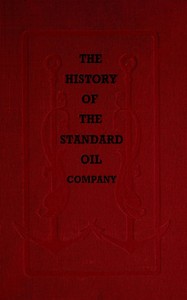
The History of the Standard Oil Company — Reading Companion
(0 User reviews)
132
Project Gutenberg
2019
Not confirmed
Standard Oil Company -- History; Petroleum industry and trade -- United States -- History
Readers of public-domain and historical texts
Project Gutenberg digital edition
en
Edition facts
Words
298,941
Reading time
1300 min
Text sections
75
The source record for The History of the Standard Oil Company — Reading Companion measures this digital text at 298,941 words, 21 hr 40 min estimated reading time, and 75 detected text sections.
The text analysis averages about 22.4 words per sentence, while the detected sections provide another way to judge how the source is divided.
Project Gutenberg metadata also associates the work with “Standard Oil Company -- History,” connecting these edition facts with the source record’s subject description.
Source:
Project Gutenberg record #60692
Ida M. Tarbell's investigative history traces Standard Oil's rise through detailed examination of railroad rebates, pipeline wars, and market manipulation, using contracts, testimony, and corporate records to expose the methods behind John D. Rockefeller's monopoly.
Read the complete public-domain text at its original source.
Read on Project GutenbergIda M. Tarbell opens her history not with a narrative flourish but with a legal document: the full text of an 1870s agreement between the Pennsylvania Railroad and several oil shippers, including John D. Rockefeller. The contract explicitly promises equal rates and car distribution—yet the entire book is an indictment of how such promises were systematically broken. Tarbell's method is forensic: she lets the paper trail speak. The preface explains that McClure's Magazine chose Standard Oil because it was "the first in the field" and "the most perfectly developed trust in existence," and that its story would "illuminate the subject of combinations of capital." This is not a biography of Rockefeller but a study of a system, built from contracts, congressional testimony, and railroad records.
The Contract as Evidence
Tarbell's reliance on primary documents sets her work apart from earlier trust exposés. She reproduces the Pennsylvania Railroad agreement in full, with its three numbered clauses promising nondiscrimination. But the surrounding narrative reveals that such agreements were routinely violated: the railroad paid rebates to Standard while denying them to independents. Tarbell does not simply assert this; she quotes the contract, then cites testimony and correspondence showing the gap between promise and practice. The effect is cumulative: each broken pledge becomes a brick in the case against the monopoly.
The Language of Control
Tarbell's diction is precise and legalistic, mirroring the corporate documents she cites. She writes of "rebates, drawbacks, and commissions"—terms that recur like a refrain. Her descriptions of Standard's tactics are clinical: "undersealing," "cutting to kill," "securing reports of competitors' business from railway agents." The vocabulary is that of a prosecutor building a brief. Yet she also employs irony, as when she notes that Standard's "wonderfully efficient and economical system" included "curious practices" like bribing clerks. The contrast between the language of efficiency and the reality of espionage is a subtle rhetorical weapon.
The Geography of Monopoly
Tarbell structures her narrative around the physical infrastructure of the oil industry: the wells, refineries, pipelines, and railroads. Chapter titles like "The Fight for the Seaboard Pipe-Line" and "Cutting to Kill" map a war of movement. She describes how the Tidewater Pipe Company first pumped oil over the Appalachians, breaking the railroad's grip, and how Standard responded by buying a third of Tidewater's stock. The landscape itself becomes a character: mountains, pipelines, and rail lines are the terrain on which the battle for control is fought. Tarbell's attention to geography grounds abstract economic forces in concrete places.
The Voices of the Independents
Though Tarbell rarely quotes Rockefeller directly, she gives space to the independent refiners and producers who opposed him. Their testimony—from congressional hearings, court cases, and interviews—fills the margins of her narrative. She records their complaints about car shortages, secret rate cuts, and the intimidation of customers. These voices are not merely decorative; they provide the evidence for her claims. By letting the independents speak, Tarbell creates a polyphonic account of the trust's rise, one in which the victims of monopoly are heard as clearly as its architects.
Tarbell's history is best read not as a finished verdict but as an open investigation. The reader is invited to examine the documents alongside the author, weighing the testimony and the contracts. Pay attention to the dates, the names of railroads, the precise wording of agreements. The power of the book lies in its accumulation of detail—each piece of evidence, like a drop of oil, eventually forms a pool that cannot be ignored.
Reading Tarbell’s careful unspooling of rebates and pipeline schemes, I felt the weight of how wealth quietly reshapes a country. It made me think of another old, earnest voice asking the same hard question—why abundance breeds such want. Progress and Poverty, Volumes I and II An Inquiry into the Cause of Industrial Depressions and of Increase of Want with Increase of Wealth — Text and Context sits beside it in my mind now, two patient arguments from a different America, still murmuring to each other across the years.
There are no reviews for this eBook.
There are no comments for this eBook.
Reader reflection
How will you remember this book?
Save your reaction, strongest insight, and memorable passage.
Your progress
0
/
10
2
Did this book hold your interest?
3
How likely are you to recommend this book?
4
How demanding did the text feel?
5
How useful did the reading feel?
6
How strong was your personal connection to the text?
7
Could you see yourself revisiting this book?
8
Did it raise ideas you would like to talk about?
9
Which lesson or insight stayed with you?
10