1

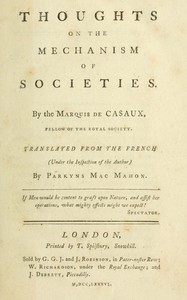
Thoughts on the mechanism of societies — Context and Discussion
(0 User reviews)
897
Project Gutenberg
2024
Not confirmed
Debts, Public -- Great Britain -- Early works to 1800; Taxation -- Great Britain -- Early works to 1800; Finance, Public -- Great Britain -- Early works to 1800; Political science -- France -- Early works to 1800
Readers of public-domain and historical texts
Project Gutenberg digital edition
en
Edition facts
Words
92,942
Reading time
405 min
Text sections
47
For Thoughts on the mechanism of societies — Context and Discussion, the stored edition analysis reports 92,942 words, 6 hr 45 min estimated reading time, and 47 detected text sections.
The text analysis averages about 44.4 words per sentence, while the detected sections provide another way to judge how the source is divided.
Project Gutenberg metadata also associates the work with “Debts, Public -- Great Britain -- Early works to 1800,” connecting these edition facts with the source record’s subject description.
Source:
Project Gutenberg record #73958
An editorial note on Casaux's 1786 work examining England's national debt and taxation through a mechanistic lens, focusing on the tension between landed and moneyed interests, the role of exportation, and the author's rhetorical strategy of hypothetical scenarios.
Read the complete public-domain text at its original source.
Read on Project GutenbergCasaux opens his Thoughts on the mechanism of societies by framing the national debt of England as the most striking object of general interest, one that could entice readers progressively into an investigation of details little known or greatly mistaken. The preface, written by the editor, signals that this is not a treatise but a collection of thoughts, freeing the author from a regular plan. This structural choice allows Casaux to begin with a provocative claim: that England in 1779, despite its formidable debt, was richer than at the start of the century—either fourfold or double, depending on the rate of population adopted. The author does not affix any importance to the difference of opinions on this article, a telling dismissal that prioritizes the mechanism of debt over demographic precision.
The Rhetoric of Hypothetical Taxation
Casaux employs a striking hypothetical to expose the flaws in prevailing tax systems. He imagines a tax of 10 millions assessed so ably and charitably that 5 millions fall on the landlord and 5 on the richest proprietor of money. This scenario is presented in all its glory, as all ministers of finance seem to wish it, and as all English newspapers recommend it, each at least once a week. The author then systematically dismantles the assumption. The land-proprietor's revenue is only the third part of the real produce of his lands, estimated at 20 millions. Under the tax, that third is reduced by 25 per cent, leaving the proprietor unable to pay industry its accustomed portion. The chain of consequences is laid out: industry is debarred from sale, artificers are left without resource, and the main object of taxation is defeated—unless exportation compensates for the loss of home-consumption, the only one by which a State can prosper. Casaux notes that draw-backs granted on exportation prove such an expedient was never adopted in England, undercutting the entire edifice.
Landed Property as the Foundation
Throughout the excerpt, Casaux insists that the State is certainly founded on the landed property. This assertion grounds his analysis in a material base: the land-proprietor is fast bound to his land by the roots of every plant he has laid on it. When faced with a tax that squeezes his income, the proprietor cannot flee to another country where good men content themselves with declaiming against luxury without making any attempt to destroy it. Instead, he must raise the price of his land's productions in proportion to the tax. This forced adjustment shifts the burden onto consumers and industry, revealing a systemic tension. Casaux's language is precise: the land-proprietor is short by 25 per cent of the sum required to pay that portion, and the only alternative is to leave industry in possession of one fifth of its former comforts—a phrase that underscores the zero-sum logic of the mechanism. The author does not moralize but traces the mechanical consequences of policy choices.
The Role of Exportation and Home-Consumption
Casaux introduces a critical distinction between home-consumption and exportation. He argues that a State can prosper only by home-consumption; exportation is a secondary, compensatory mechanism. In his hypothetical, if the land-proprietor cannot consume the fifth part of national commodities, industry must export that surplus to be reimbursed the tax she has advanced. But Casaux questions whether such exports truly benefit the nation: industry would have derived less advantage from a foreign sale than from a home-sale, even supposing the inconvenience of which I shall speak presently. The land proprietors would have some reason to complain, and the rest of the nation would have no cause to boast of the immensity of her exportation. This passage reveals a skepticism toward export-led growth that anticipates later economic debates. The author's voice is ironic, especially when he lists the various preachers—Roman, English, Jansenist, Presbyterian—who deliver partly christian, partly political reflexions on taxation, suggesting that even pulpit oratory is enlisted in the service of fiscal policy.
Readers should attend to Casaux's method of building arguments through layered hypotheticals and his habit of dismissing alternative viewpoints with a wave of the hand. The text rewards careful parsing of conditional clauses and ironic asides. The mechanistic metaphor is not merely decorative; it structures the analysis of debt, taxation, and property as interlocking parts of a system that can be modeled and critiqued. The translation by Parkyns MacMahon, produced under the inspection of the author, preserves the rhetorical force of the original French, making this a valuable document for understanding late Enlightenment political economy.
Reading Casaux's careful weighing of landed against moneyed interests, I found myself thinking of how every era has its quiet casualties, the ones whose stories get simplified. That tension reminded me of a particular book, Betsy Gaskins (Dimicrat), Wife of Jobe Gaskins (Republican) Or, Uncle Tom's Cabin Up to Date — Reading Companion, where the same unspoken ache seems to linger between the lines, just below the arguments.
There are no reviews for this eBook.
There are no comments for this eBook.
Reader reflection
How did this book work for you?
Your answers remain private and are stored only in this browser.
Your progress
0
/
10
2
What was your overall reaction to the book?
3
Would you recommend this book to another reader?
4
How much effort did this book require?
5
Could you see yourself revisiting this book?
6
Did anything about the book feel genuinely new?
7
Did you gain anything practical from the text?
8
How closely did the book connect with your experience?
9
Which lesson or insight stayed with you?
10