About 44 minutes
The Young Man in Business — Text and Context
Economics
10,091 recorded words. 0 minutes difference from this book's estimate.
View Gutenberg source #31494
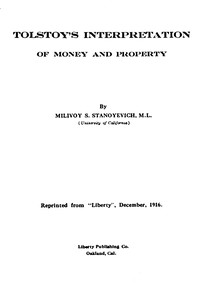
The source record for Tolstoy's interpretation of money and property — Key Ideas to Explore measures this digital text at 9,945 words, 44 min estimated reading time, and 2 detected text sections.
The text analysis averages about 19.2 words per sentence, while the detected sections provide another way to judge how the source is divided.
Project Gutenberg metadata also associates the work with “Tolstoy, Leo, graf, 1828-1910,” connecting these edition facts with the source record’s subject description.
Explore this collection
These alternatives are selected using recorded categories and estimated reading time.
About 44 minutes
Economics
10,091 recorded words. 0 minutes difference from this book's estimate.
View Gutenberg source #31494About 43 minutes
Economics
9,789 recorded words. 1 minutes difference from this book's estimate.
View Gutenberg source #29499About 43 minutes
Economics
9,671 recorded words. 1 minutes difference from this book's estimate.
View Gutenberg source #51244Search stored excerpts and compare books → Choose by your preferences →
Choices use stored catalog measurements. Estimates vary with reading speed. A shared category is a catalog label, not a claim that two books have the same argument or literary quality.
Search reads excerpt text stored with this catalog and links to its associated Gutenberg record. The connection is stored in the site database; this tool does not recheck that every excerpt is word-for-word identical to that external record. Excerpt search does not cover every chapter and does not verify historical publication dates.
Catalog snapshot checked: 2026-09-25. Coverage: 100 public books, 100 available source excerpts.
Read the complete public-domain text at its original source.
Read on Project GutenbergStanoyevich opens by positioning Tolstoy as a consistent social reformer who rejects positive law, private property, and money as inherently violent. The essay immediately sets up a central tension: Tolstoy's moral condemnation of money versus the functional definitions offered by economists like Fisher and Kinley. By quoting Tolstoy's own question—"What is money?"—from What Shall We Do Then, Stanoyevich anchors the analysis in the reformer's own words, then systematically contrasts his answers with those of Smith, Ricardo, Mill, and Marx.
The first section of the essay is structured as a debate. Stanoyevich lists the four functions of money according to economic science—convenience of exchange, measure of value, saving, and payments—and then reports Tolstoy's flat rejection of each. The author does not merely summarize; he juxtaposes Tolstoy's claim that money is a "medium of oppression" with the neutral definitions of classical and socialist economists. Notably, Stanoyevich includes Marx and Lassalle among those who "agree in the main" that money is an exchangeable commodity, suggesting that Tolstoy's dissent cuts across ideological lines. The section also introduces Kinley's threefold service definition, which emphasizes function over material, a nuance that Tolstoy's moral framework appears to bypass entirely.
Stanoyevich then turns to property, where Tolstoy's argument becomes more concrete. The essay reports Tolstoy's claim that rural laborers need neither strikes nor parliamentary representation; instead, they should demand the right to settle on land and work it, an "unquestionable and inalienable right" inherent in every living being. The author traces this logic to its radical conclusion: when police and army—themselves workingmen—refuse to enforce property claims, the people can simply take the land. Stanoyevich notes the direct lineage from Proudhon's "La propriété c'est le vol" to Tolstoy's "Sobstvenost est koren zla" (Property is the root of evil), and then immediately asks whether this statement is categorical. The answer is split: categorical for Tolstoy and Proudhon, but at fault from the standpoint of economists.
The final section widens the lens to ancient and modern history. Stanoyevich invokes Plato's communism in the Republic—land divided equally, no private property beyond necessity—and Aristotle's rebuttal in the Politics, which favored "private property and common use." The author then cites Mommsen's Roemische Geschichte to argue that early arable land was cultivated in common, only later distributed as private property. This historical evidence, supported by Cicero, Dionysius, and Plutarch, is marshaled to suggest that Tolstoy's ideal of common land is not novel but echoes ancient practice. Stanoyevich does not resolve the debate; he leaves it as a quaestio vexata—a vexed question—acknowledging that history and economics offer conflicting verdicts on Tolstoy's solution.
Readers should note that Stanoyevich's essay is itself a document of its time—published in 1916, it treats Tolstoy as a living intellectual force rather than a historical figure. The author's method is comparative and dialogic: he lets Tolstoy's words stand alongside those of economists and historians, forcing the reader to weigh competing frameworks. The excerpts provided do not include Stanoyevich's own conclusion, so the essay's final judgment remains unknown. What is clear is that the work is less a biography or summary than a focused argument about the moral foundations of economic life.
Years among the shelves taught me that Tolstoy’s fierce denial of property finds a strange, quiet echo in the wallets of old Europe. The Paper Moneys of Europe: Their Moral and Economic Significance — Inside the Classic traces those slips of promise without ever raising its voice, a patient ledger of belief and ruin. I have always found their kinship in how gently they question what we call our own. A private sort of understanding, that.
Save your reaction, strongest insight, and memorable passage.