About 52 minutes
Creating Capital Money-making as an aim in business — Inside the Classic
Economics
11,787 recorded words. 0 minutes difference from this book's estimate.
View Gutenberg source #29673
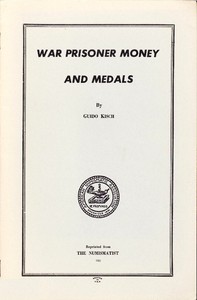
Before opening War Prisoner Money and Medals — A Closer Reading, the edition data offers a quick orientation: 11,761 words, 52 min estimated reading time, and 2 detected text sections.
The text analysis averages about 16.1 words per sentence, while the detected sections provide another way to judge how the source is divided.
Project Gutenberg metadata also associates the work with “Money,” connecting these edition facts with the source record’s subject description.
Explore this collection
These alternatives are selected using recorded categories and estimated reading time.
About 52 minutes
Economics
11,787 recorded words. 0 minutes difference from this book's estimate.
View Gutenberg source #29673About 44 minutes
Economics
10,091 recorded words. 8 minutes difference from this book's estimate.
View Gutenberg source #31494About 44 minutes
Economics
9,945 recorded words. 8 minutes difference from this book's estimate.
View Gutenberg source #66544Search stored excerpts and compare books → Choose by your preferences →
Choices use stored catalog measurements. Estimates vary with reading speed. A shared category is a catalog label, not a claim that two books have the same argument or literary quality.
Search reads excerpt text stored with this catalog and links to its associated Gutenberg record. The connection is stored in the site database; this tool does not recheck that every excerpt is word-for-word identical to that external record. Excerpt search does not cover every chapter and does not verify historical publication dates.
Catalog snapshot checked: 2026-09-25. Coverage: 100 public books, 100 available source excerpts.
Read the complete public-domain text at its original source.
Read on Project GutenbergGuido Kisch's 'War Prisoner Money and Medals' opens with a striking juxtaposition: the humanitarian ideals of international law and the brutal reality of prisoner treatment. The text moves from the Geneva Conventions to the 'barbarism' of Malmedy and Auschwitz, then pivots to the practical necessity of issuing special camp currency. This shift—from ethical code to economic measure—sets the pattern for a work that constantly balances abstract principles with tangible artifacts.
The first section establishes the legal framework for prisoner treatment, then quickly narrows to the monetary problem. Kisch notes that currency shortages during war make special money a 'national defense' measure. He describes how this money is restricted in two ways: circulation limited to prisoners, and even more strictly to specific camps. The physical design—often a round or square hole—serves as a visible marker of exclusion. The text cites German Gefangenenlagergeld and French monnaies des camps de prisonniers, grounding the discussion in specific national practices.
The second section examines a medal from the Libby Prison War Museum in Chicago. Kisch reproduces its eighteen-line legend verbatim, which recounts the prison's history from 1845 to its relocation. He notes a surprising omission: the prison commander Major Thomas P. Turner, described by a former prisoner as 'always a gentleman,' is absent. The medal's reverse features clasped hands and crossed sabres, with the motto 'NO SECTIONALISM—1861—NO NORTH—NO SOUTH—1865—NO ANIMOSITY.' This artifact, Kisch implies, tells a selective story of reconciliation.
Kisch quotes a rare museum catalogue describing the physical removal of Libby Prison from Richmond to Chicago. Each board, beam, and stone was 'numbered and lettered' for reassembly, requiring 132 twenty-ton cars. The museum opened in 1889 but failed financially, torn down in 1899. Only the prison wall remains, incorporated into the Coliseum's facade. This material history—the building as artifact—mirrors the medals and currency Kisch studies: objects that carry memory but are subject to decay and repurposing.
Kisch's method is cumulative: he presents legal texts, then specific examples, then detailed descriptions of individual pieces. The Libby Prison section includes a bibliography of 222 items from the New York Public Library, signaling the depth of available sources. Yet the text remains focused on the objects themselves—their design, issuance, and circulation. The movement from international law to a single medal's legend shows how macro and micro scales interact. Kisch does not claim completeness; he offers a framework for understanding these specialized currencies as both economic tools and historical witnesses.
Readers should approach this work as a focused study of material culture within a legal and economic framework. The excerpts reveal a text that moves between the general and the particular, always grounding its claims in specific artifacts. Kisch's attention to the physical details of money and medals—holes, legends, materials—offers a model for analyzing how objects encode the conditions of their creation. The incomplete nature of the excerpts means some connections remain implicit, but the pattern of argument is clear.
I’ve spent many long afternoons with War Prisoner Money and Medals, tracing how men in desperate circumstances made meaning from scraps of stamped tin. It reminds me, oddly, of a quieter volume I shelved years ago, the eleventh Little Journeys to the Homes of the Great - Volume 11 Little Journeys to the Homes of Great Businessmen — Inside the Classic. Both speak of holding onto dignity—one through bars, one through ledgers.
Your answers remain private and are stored only in this browser.