1

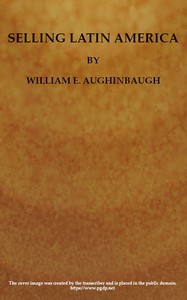
Selling Latin America: A Problem in International Salesmanship. What to Sell and How to Sell It — Inside the Classic
(0 User reviews)
383
Project Gutenberg
2019
Not confirmed
Latin America -- Economic conditions; Latin America -- Commerce -- United States; United States -- Commerce -- Latin America; Latin America -- Commerce
Readers of public-domain and historical texts
Project Gutenberg digital edition
en
Edition facts
Words
66,945
Reading time
292 min
Text sections
38
This digital edition of Selling Latin America: A Problem in International Salesmanship. What to Sell and How to Sell It — Inside the Classic is described by source-level measurements including 66,945 words, 4 hr 52 min estimated reading time, and 38 detected text sections.
The text analysis averages about 24.8 words per sentence, while the detected sections provide another way to judge how the source is divided.
Project Gutenberg metadata also associates the work with “Latin America -- Economic conditions,” connecting these edition facts with the source record’s subject description.
Source:
Project Gutenberg record #60150
A 1915 guide by a globe-trotting doctor on selling to Latin America, blending firsthand travel anecdotes with blunt advice on product suitability, local customs, and the competitive tactics of European traders.
Read the complete public-domain text at its original source.
Read on Project GutenbergWilliam E. Aughinbaugh opens Selling Latin America not with theory but with a foreword that catalogs his own travels: thirty-six trips across the Equator, business missions in Egypt, and journeys through every habitable spot in the West Indies and South America. This personal authority shapes the book’s voice—direct, anecdotal, and impatient with ignorance. Aughinbaugh writes as a practitioner, not an academic, and his prose moves briskly between concrete examples: the man trying to sell snow plows in Brazil, the canoe company advertising in a waterless Argentine region. The narrative pace shifts from brisk indictment of American exporters to detailed exposition of German, English, and French methods, each described with a salesman’s eye for strategy.
The Voice of Experience
Aughinbaugh’s narrative voice is that of a seasoned traveler who has earned the right to be blunt. He does not hedge: “It is quite apparent that no amount of exploitation or argument could possibly produce results with such a commodity,” he says of the snow-plow salesman. This directness is consistent throughout the excerpts, whether he is dismissing ill-adapted products or praising German “deliberately planned aggressiveness.” The foreword, written by a colleague, emphasizes that Aughinbaugh “speaks the languages of many countries and speaks them well,” and this linguistic competence undergirds his credibility. He does not rely on secondhand reports; his observations are framed as firsthand, and he frequently uses the first person to describe specific encounters—the breweries he saw, the trade problems he solved. This personal testimony gives the book a conversational, almost advisory tone, as if he is speaking directly to a fellow exporter.
Pace and Structure: From Anecdote to Analysis
The book’s pacing alternates between sharp, illustrative anecdotes and broader strategic analysis. In the excerpts, a short, vivid story—such as the bull frogs dying of old age without a swim—is followed by a methodical breakdown of how to gather market data, including a recommendation to consult U.S. consuls. This rhythm keeps the reader engaged while delivering practical instruction. The chapter “Methods of Doing Business” exemplifies this: it begins with a categorical statement about capital and product nature, then immediately pivots to a cautionary tale about inappropriate goods. Aughinbaugh’s sentences vary in length; some are terse and punchy, others more elaborate when describing the commercial history of European nations. The overall effect is a text that feels both urgent and thorough, mirroring the author’s own restless energy as a businessman who has “been engaged in these special fields for more than twenty years.”
Recurring Details: Climate, Competition, and Common Sense
Three motifs recur in the excerpts: climate, competition, and the need for preliminary investigation. Aughinbaugh includes a map comparing South American and U.S. climates, and he repeatedly stresses that goods must suit local conditions—heating systems are useless in most of South America, and snow plows are absurd. Competition is framed as a contest among nations: Germany’s “solidarity of purpose,” England’s infrastructure investments, France’s reliance on fashion. Aughinbaugh’s own advice is pragmatic: “make a full and exhaustive investigation through all possible sources of information.” These details are not merely decorative; they form the book’s argument that success in Latin America requires adapting to specific realities rather than imposing American assumptions. The author’s tone is consistently that of a mentor who has seen costly mistakes and wants to prevent them.
Readers approaching Selling Latin America should expect a hybrid work: part travel memoir, part export manual, part competitive analysis. Aughinbaugh’s authority rests on his own travels, not on academic research, and his advice is grounded in concrete examples rather than abstract principles. The book rewards those who read for both its practical tips and its portrait of early twentieth-century global commerce. Pay attention to the asides—they often contain the most telling observations about how business was actually conducted.
That old doctor’s book reads less like salesmanship and more like a diary of what happens when optimism bumps into stubborn reality. His gentle frustration about European competitors stuck with me, the way he gestures at their confidence without quite naming it. It trails naturally toward The British Jugernath: Free trade! Fair trade!! Reciprocity!!! Retaliation!!!! — A Reader’s Guide, which turns that same quiet rivalry into a louder, older argument. Both feel like voices from a parlor, still murmuring.
There are no reviews for this eBook.
There are no comments for this eBook.
Reader reflection
How did this book work for you?
Your answers remain private and are stored only in this browser.
Your progress
0
/
10
2
How much did you enjoy the reading experience?
3
How likely are you to recommend this book?
4
What was the reading difficulty like?
5
Did the book deliver what you hoped for?
6
How did the pace of the book feel?
7
What was its emotional impact?
8
Would a second reading be valuable?
9
In one sentence, what did you learn?
10