About 220 minutes
The Economics of the Russian Village — A Reader’s Guide
Economics
50,577 recorded words. 7 minutes difference from this book's estimate.
View Gutenberg source #50023
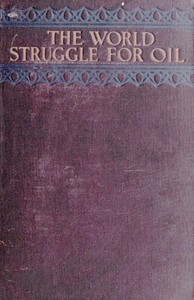
The catalog record for The World-Struggle for Oil — Story, Setting & Ideas provides practical reading context through 51,986 words, 3 hr 47 min estimated reading time, and 8 detected text sections.
The text analysis averages about 20.1 words per sentence, while the detected sections provide another way to judge how the source is divided.
Project Gutenberg metadata also associates the work with “War -- Economic aspects,” connecting these edition facts with the source record’s subject description.
Explore this collection
These alternatives are selected using recorded categories and estimated reading time.
About 220 minutes
Economics
50,577 recorded words. 7 minutes difference from this book's estimate.
View Gutenberg source #50023About 237 minutes
Economics
54,465 recorded words. 10 minutes difference from this book's estimate.
View Gutenberg source #65278About 244 minutes
Economics
56,042 recorded words. 17 minutes difference from this book's estimate.
View Gutenberg source #39653Search stored excerpts and compare books → Choose by your preferences →
Choices use stored catalog measurements. Estimates vary with reading speed. A shared category is a catalog label, not a claim that two books have the same argument or literary quality.
Search reads excerpt text stored with this catalog and links to its associated Gutenberg record. The connection is stored in the site database; this tool does not recheck that every excerpt is word-for-word identical to that external record. Excerpt search does not cover every chapter and does not verify historical publication dates.
Catalog snapshot checked: 2026-09-25. Coverage: 100 public books, 100 available source excerpts.
Read the complete public-domain text at its original source.
Read on Project GutenbergL'Espagnol de la Tramerye opens his study with a blunt declaration: 'Who has oil has empire!' This phrase sets the tone for a work that treats petroleum as the central strategic commodity of the early twentieth century. The book, translated from French by C. Leonard Leese, moves from a survey of global oil deposits to a detailed account of the corporate and state actors vying for control. The author's voice is direct and often polemical, particularly when describing the actions of the British government and the Royal Dutch-Shell group. He presents oil not merely as an economic good but as a source of geopolitical power, with alliances and conflicts shaped by access to reserves.
The book's structure mirrors its argument: after establishing the importance of oil, it devotes sections to the major trusts—Standard Oil, Royal Dutch-Shell—and then to the struggles between nations. The author's narrative voice is that of a commentator who sees conspiracy and calculation behind every corporate move. He describes the British Controlled Oil-fields company as 'specially commissioned to fight the Standard Oil,' and notes its concessions 'surround two-thirds of the Caribbean Sea.' The language is often dramatic: the company's concessions are chosen 'as a precaution in case war should break out between Britain and the United States.' This framing turns corporate geography into a map of potential conflict.
The writing alternates between broad geopolitical claims and granular financial or territorial specifics. Early chapters move quickly through global production statistics and the history of oil. Later sections slow to describe particular concessions, capital figures, and diplomatic incidents. For example, the account of British intervention in Costa Rica includes precise dates—'February 28, 1921'—and the name of the cruiser Cambrian. This shift in pace gives the reader a sense of moving from a wide-angle view to a close-up of a single contested region. The author's willingness to name individuals, such as 'Mr. Alves, Chairman of the British Controlled Oil-fields,' adds a journalistic texture to the analysis.
As a translation, the book carries the original French author's perspective, which is notably critical of British and American oil imperialism. The translator, C. Leonard Leese, preserves the author's assertive tone and occasional sarcasm. The text refers to 'the imbroglio of British and American affairs around the Gulf of Mexico' and describes how Great Britain 'did not hesitate to foment revolution' in Costa Rica to secure concessions. This viewpoint is consistent throughout, though the author also notes American interventions, such as when 'an American naval detachment assisted the Costa Rican forces.' The book's structure—moving from the world's oil to the trusts to the powers—reflects a deliberate escalation from economic to political analysis.
Readers should approach this book as a contemporary document of the interwar period, written before the full consolidation of the oil industry. The author's claims about secret diplomacy and corporate influence are presented as fact, but the excerpts do not provide evidence for every assertion. The work is most valuable for its detailed account of specific concessions and corporate structures, and for its unapologetic framing of oil as a driver of international conflict. Those interested in the history of energy geopolitics will find a vivid, if partisan, snapshot of the world in 1923.
I’ve spent many evenings with that old volume on the oil wars, noting how empires hoarded their black gold as though it were eternal life. The same covetousness lives in quieter pages, where another great mind reckoned with what we cling to. There’s a strange kinship there. Tolstoy's interpretation of money and property — Key Ideas to Explore circles the same hunger, albeit with softer footsteps.
Save your reaction, strongest insight, and memorable passage.